How to Build an EVP That Attracts Top Talent (2026)
Build an EVP that reduces turnover by up to 69% and boosts new hire commitment by 30%. 5-pillar framework, step-by-step guide, and 2026 AI trends.
Build an EVP that reduces turnover by up to 69% and boosts new hire commitment by 30%. 5-pillar framework, step-by-step guide, and 2026 AI trends.
An employee value proposition is the total package of rewards, culture, growth, and purpose your company offers in exchange for a person's talent - and building a strong one is the single most effective way to attract and keep the people you need. Organizations that deliver on their value proposition reduce annual turnover by up to 69% and increase new hire commitment by nearly 30%, according to Gartner. Yet only 33% of employees say their organization actually follows through on its promises, per Gartner's 2024 survey of 1,300+ employees.
That gap between what companies promise and what employees experience is where most value propositions fail. This guide walks you through the five pillars every strong EVP needs, a step-by-step process to build yours, and the 2026 trends reshaping what candidates actually want.
TL;DR: An EVP defines the total value employees get from working at your company. A strong one cuts turnover by up to 69% (Gartner) and reduces the salary premium needed to attract talent by 50%. Build yours around five pillars: compensation, career growth, flexibility, culture, and well-being. Then communicate it across every candidate touchpoint - most employees don't even know what their company's EVP includes.
An employee value proposition is the unique set of benefits and experiences a company offers its employees in return for their skills, capabilities, and commitment. Think of it as the answer to one question every candidate asks silently: "Why should I work here instead of somewhere else?"
It's not your mission statement. It's not a list of perks on a careers page. It's the honest, specific answer to what people actually get from being part of your organization - from compensation and career paths to the daily reality of how work feels.
Here's what makes an EVP different from employer branding: your employer brand is how the outside world perceives you as a place to work. Your value proposition is the substance behind that perception. Employer branding is the marketing. The value proposition is the product.
A strong value proposition answers five questions:
Most companies have an implicit value proposition whether they've defined one or not. Candidates already form opinions based on your Glassdoor reviews, interview experience, and what current employees say over coffee. The question isn't whether you have one - it's whether you're shaping it intentionally or letting it define itself.
Only 21% of global employees are engaged at work - down from 23% the prior year - according to Gallup's 2025 State of the Global Workplace report. That means 79% of your workforce is either going through the motions or actively working against your organization's goals. A clear value proposition doesn't fix disengagement overnight, but it sets the foundation for why people should care.
The financial case is blunt. Disengaged employees cost the global economy $438 billion in lost productivity annually, per the same Gallup study. Meanwhile, 50% of employees globally are watching for or actively seeking a new job. Every person who leaves costs roughly 50-200% of their annual salary to replace, depending on the role.
Here's what happens when organizations get their EVP right:
That last point deserves attention. When your proposition is strong enough that candidates come to you - through referrals, organic applications, and reputation - you spend less time and money chasing them down. Your recruitment marketing works harder because there's real substance behind the messaging.
And yet most companies are failing at the basics. Gartner's 2024 survey revealed that only 16% of employees even know what their organization's value proposition includes. Just 21% say their company communicates it enough. You can't attract talent with a promise that nobody - including your own people - has heard.

Salary and benefits still top the list globally - 72% of workers rank them as the most important factor when evaluating employers, according to the Randstad Employer Brand Research 2025 (170,000+ respondents across 34 markets). But compensation alone isn't enough. Work-life balance follows at 66%, and the gap between those two has been narrowing year over year. Candidates want the whole picture.
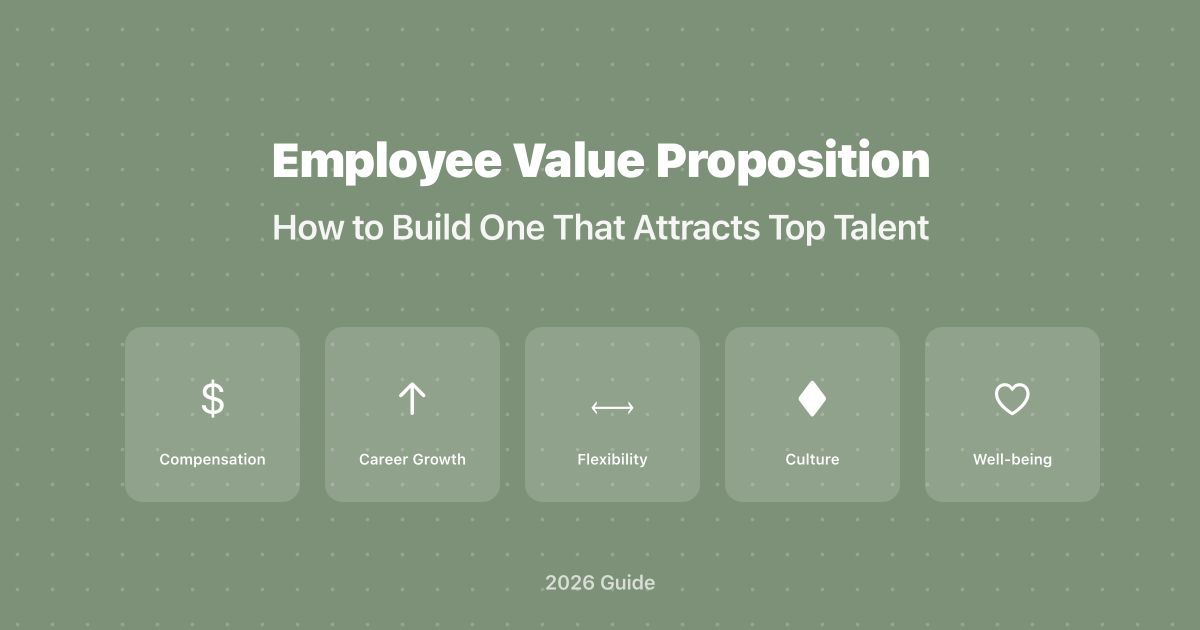
A complete proposition rests on five pillars. Each one matters, and weakness in any single area can undermine the others.

This is the foundation. No amount of ping-pong tables or unlimited PTO compensates for below-market pay. Compensation includes base salary, variable pay, equity, health insurance, retirement contributions, and time off. It's the most tangible pillar and the one candidates evaluate first.
The key word here is "total." Many companies underpay on base salary but offer meaningful equity, strong 401(k) matching, or generous parental leave. Others lead on salary but skimp on benefits. Present the complete picture - and be honest about trade-offs. If you're a startup that can't match enterprise salaries, say so. Then show what you offer instead.
Career development is the fourth-largest driver globally at 52% (Randstad, 2025), and for younger workers it ranks even higher. This pillar covers promotion pathways, mentorship, training budgets, stretch assignments, and internal mobility opportunities.
Don't confuse this with "we have a learning platform nobody uses." The promise here needs to be specific: How many internal promotions happened last year? What percentage of roles were filled internally? Do managers actively discuss career development in one-on-ones? Vague promises about "growth opportunities" read as empty. Concrete numbers build trust.
Work-life balance ranks second globally at 66%, and the gap with salary keeps shrinking. This pillar addresses where, when, and how work happens. Remote options. Hybrid schedules. Compressed workweeks. Results-focused policies that measure output rather than hours logged.
Flexibility became non-negotiable after 2020. The companies trying to pretend otherwise are seeing it in their attrition numbers. If your messaging says "flexible work" but your managers expect everyone online from 9 to 5, you have a delivery problem - and employees will flag it on Glassdoor.
Half of all workers globally rank a "pleasant working atmosphere" as a top-five employer attribute (Randstad, 2025). This pillar covers mission alignment, psychological safety, inclusion, recognition programs, and leadership quality.
Culture is the hardest pillar to fake and the easiest to verify. Candidates read reviews. They ask connections who work there. They notice how interviewers treat them. If your proposition promises an inclusive, purpose-driven culture, every interaction during the candidate experience needs to reflect it.
Mental health has moved from a "nice to have" to a hygiene factor. One in three employees globally reports experiencing anxiety or depression, and younger workers increasingly rank mental health resources as a top priority. This pillar covers physical health benefits, mental health support, financial wellness programs, and employee assistance resources.
The strongest propositions go beyond listing an EAP phone number. They address workload sustainability, manager training on recognizing burnout, and proactive well-being initiatives. Companies that treat well-being as a checkbox are losing talent to those that treat it as infrastructure.
| Pillar | What to Include | How to Measure |
|---|---|---|
| Compensation & Total Rewards | Base salary, equity, benefits, retirement, PTO | Market percentile rank, offer acceptance rate |
| Career Growth & Learning | Promotion pathways, mentorship, training budgets, internal mobility | Internal promotion rate, training hours per employee |
| Work Flexibility | Remote/hybrid options, schedule autonomy, compressed weeks | Flexibility satisfaction score, attrition by work model |
| Culture, Purpose & Belonging | Mission alignment, inclusion, recognition, leadership quality | eNPS, Glassdoor culture rating, belonging survey scores |
| Health, Well-being & Support | Mental health resources, financial wellness, EAP, workload policies | Utilization rates, burnout/stress survey scores |
80% of executive management teams now consider employer branding an important priority, according to Universum's Employer Branding NOW 2025 report. But priority doesn't equal execution. Here's a practical process for building one that actually works.
Before you define what your EVP should be, find out what it already is. Every company has an implicit proposition - the question is whether it matches what leadership thinks.
The audit usually reveals a gap between what leadership believes and what employees actually experience. That gap is your starting point.
Your proposition needs to resonate with the people you're trying to attract - not just the ones you already have. Different roles, generations, and geographies prioritize different things.
Now synthesize. For each of the five pillars, write a clear, honest statement about what you offer. No aspirational language - just facts.
Test each statement with this filter: "Could a competitor say the exact same thing?" If yes, it's not differentiated enough. "Competitive salary" means nothing. "Top-quartile salary plus 4% 401(k) match and equity for all employees" says something specific.
Here's a framework for structuring each pillar:
Before you plaster your EVP across your careers page, test it with real people.
A documented value proposition that lives in an HR slide deck isn't actionable - it's a document. Activation means embedding your value proposition into every touchpoint where candidates and employees interact with your company.
Here's the communication multiplier: for every additional channel you use to communicate your proposition, employees are 24% more likely to agree the organization delivers on its promises, according to Gartner's 2024 survey. One channel is a memo. Five channels is a culture.
Pin's multi-channel outreach tools help recruiting teams reach candidates across email, LinkedIn, and SMS with personalized messaging that reflects your value proposition - delivering a 48% response rate on automated outreach. See how Pin's outreach works.
More than 70% of managers and workers say they're more likely to join or stay with an organization whose value proposition explicitly addresses how AI helps them thrive, according to Deloitte's 2025 Global Human Capital Trends report (10,000 respondents across 93 countries). AI isn't just a workplace tool anymore - it's a pillar in itself.
But most organizations are getting this wrong. The same Deloitte study found that 77% of employees say AI has actually increased their workloads, and 61% believe it will lead to more burnout. Meanwhile, 77% of organizations are not meaningfully sharing AI-created productivity rewards with their workers.
That disconnect creates both a risk and an opportunity for your EVP:
The risk: If AI tools are dumping more work on people without clear benefit - more reports to review, more notifications, more "productivity" software tracking their keystrokes - your proposition suffers regardless of what your careers page says. Early-career workers are especially affected: 28% report losing on-the-job learning opportunities because AI handles tasks they used to learn from.
The opportunity: Companies that position AI as an enabler rather than a replacement stand out. What does that look like in practice?
For recruiting teams specifically, AI tools are changing how the value proposition gets communicated to candidates. Instead of blasting the same generic pitch to every prospect, AI recruiting tools can personalize outreach based on what specific candidates are likely to care about - whether that's your remote work policy, your engineering culture, or your career development programs.
Your proposition is only as strong as your ability to communicate it to the right people at the right time. This is where the gap between having a value proposition and activating it becomes practical.
AI-powered recruiting platforms help close that gap in three ways:
Finding candidates who align with your EVP. Instead of spraying job ads and hoping, AI sourcing tools scan large databases to find people whose career interests, skills, and values match what you actually offer. Pin scans 850M+ candidate profiles to find people whose backgrounds and career trajectories suggest they'd value what your company provides - not just that they can do the job.
Personalizing how you communicate it. A one-size-fits-all recruiting pitch ignores everything we know about audience segmentation. Senior engineers care about different things than early-career marketers. Multi-channel outreach tools let you tailor your messaging across email, LinkedIn, and SMS. As Rich Rosen, Executive Recruiter at Cornerstone Search, puts it: "Absolutely money maker for recruiters... in 6 months I can directly attribute over $250K in revenue to Pin."
Measuring whether it lands. Response rates and acceptance rates tell you whether your messaging resonates. If candidates aren't replying, it's often not a sourcing problem - it's a positioning problem. Pin's users see a 48% response rate on automated outreach and a roughly 70% candidate acceptance rate, which suggests the combination of smart targeting and personalized messaging is delivering the right promise to the right people.
Building a talent pipeline that stays warm requires ongoing communication, not just a strong first message. AI scheduling and follow-up sequences keep candidates engaged without overwhelming your team.
Even well-intentioned efforts fail when they fall into predictable traps. Here are the five most common.
A generic value proposition that tries to appeal to all audiences appeals to none. "Great culture, competitive pay, exciting work" could describe any company. Instead, build segment-specific versions. What you emphasize to a senior data scientist should differ from what you highlight for a sales development representative.
This is the biggest killer. Gartner's data shows that 75% of HR leaders admit they're not communicating effectively - but the larger problem is organizations that communicate a polished proposition and then fail to deliver it. Every gap between promise and reality shows up on Glassdoor, in exit interviews, and in your turnover rate.
Your value proposition isn't a document you write once and file away. Markets shift. Employee expectations evolve. What attracted talent in 2024 may not work in 2026. Build a cadence for reviewing and updating - quarterly pulse checks on employee sentiment, annual competitive benchmarking, and real-time monitoring of review platforms.
Employees are 5x more likely to feel their organization delivers on its promises when they trust their manager, per Gartner. Your proposition lives or dies at the team level. If managers don't know it, can't articulate it, or worse, actively contradict it through their behavior, no amount of employer branding will save it. Train managers. Equip them with talking points. Hold them accountable.
Most of this work focuses exclusively on attracting new talent. But your current employees are both the proof point and the amplification engine. If they don't experience the proposition you're selling to candidates, two things happen: new hires feel deceived, and current employees become cynical. Always build from the inside out.
An EVP is the unique combination of compensation, benefits, career development, work flexibility, culture, and well-being that a company offers employees in exchange for their skills and commitment. According to Gartner, organizations that effectively deliver reduce annual turnover by up to 69%. It's the substance behind your employer brand - the real answer to "why should I work here?"
Your employer brand is the external perception of your company as a workplace. Your value proposition is the actual substance behind that perception - the specific rewards, experiences, and opportunities employees receive. Think of it as the product and the employer brand as the marketing. Without a strong one, employer branding is just advertising with nothing to back it up.
According to the Randstad Employer Brand Research 2025 (170,000+ respondents), the top five global drivers are: salary and benefits (72%), work-life balance (66%), job security (58%), career development (52%), and pleasant working atmosphere (50%). Notably, Deloitte's 2025 research shows that 70%+ of workers now also want their employer to address how AI will affect their role.
Track five metrics: employee engagement scores (via pulse surveys), voluntary turnover rate, offer acceptance rate, time-to-fill for open roles, and Glassdoor/Indeed ratings. Gartner's 2024 research found that only 16% of employees know what their organization offers - so also measure awareness through direct surveys asking employees to describe your value proposition in their own words.
Review at least annually with quarterly pulse checks on employee sentiment. Major triggers for an immediate update include: significant changes in compensation strategy, new remote/hybrid policies, organizational restructuring, leadership transitions, or shifts in your competitive landscape. The Deloitte 2025 report emphasizes that AI integration is the newest trigger - 77% of companies haven't addressed how AI affects their proposition, which creates an immediate gap.
Build your talent pipeline with Pin's AI recruiting assistant