Internal Mobility: How to Fill Roles With Existing Talent (2026)
Internal mobility costs 3-5x less and fills roles 10-12 days faster than external hiring. 7 proven strategies to build a program that retains top talent.
Internal mobility costs 3-5x less and fills roles 10-12 days faster than external hiring. 7 proven strategies to build a program that retains top talent.
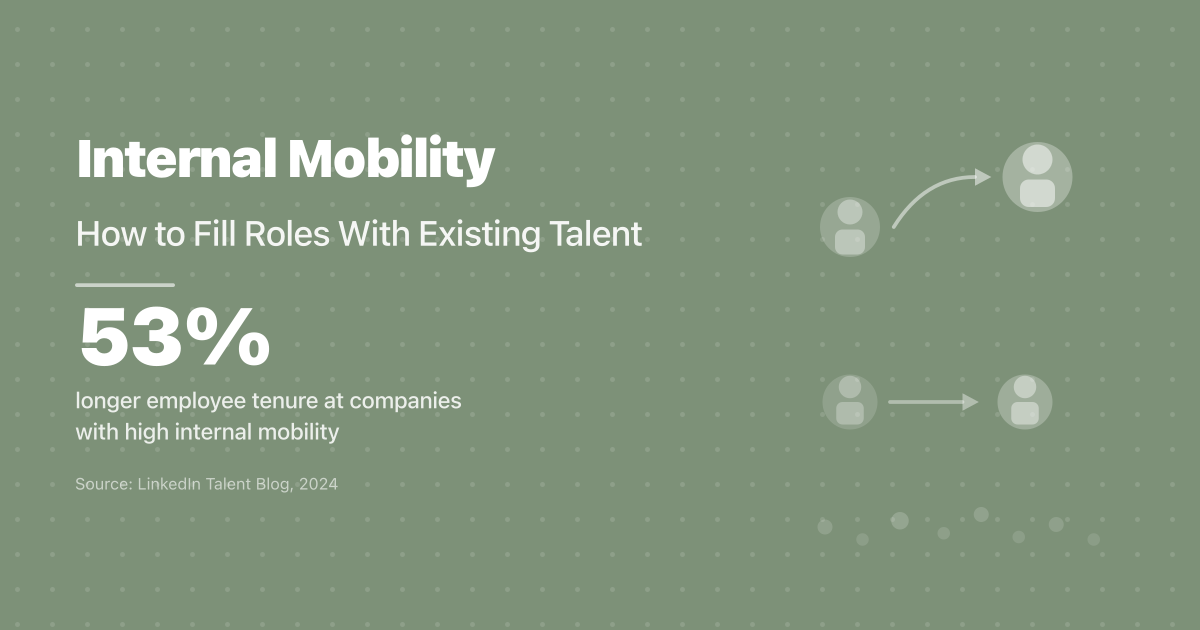
Internal mobility - moving existing employees into new roles through promotions, lateral transfers, or stretch assignments - is one of the most effective ways to fill open positions faster, cheaper, and with better outcomes than external hiring. According to the Josh Bersin Company (2023), external hiring costs 3-5x more than an internal placement when you account for sourcing, interviewing, onboarding, and ramp-up time. Yet over 80% of role changes still involve switching employers entirely, per McKinsey's analysis of 4M+ work histories (2024).
That's a massive missed opportunity. This guide breaks down why this approach matters, what's blocking it at most companies, and seven concrete steps to build a program that actually works.
TL;DR: Internal hires cost 3-5x less, reach productivity faster, and stay 53% longer (LinkedIn, 2024). Yet only 33% of companies have a formal program for internal hiring. Seven strategies below - from building a live skills inventory to handling internal rejections - help recruiting teams fill more roles from within. For roles that do require external candidates, Pin covers the gap - rated 4.8/5 on G2, it scans 850M+ profiles and fills positions in an average of 14 days.
This talent strategy fills open roles with people who already work at your company. It covers four main types of movement:
All four types strengthen employee retention - not just promotions. The mistake most companies make is treating only vertical moves as "real" talent mobility and ignoring the rest. Lateral movers see a 62% retention boost (Josh Bersin Factbook, 2023) - nearly as high as promoted employees at 70%.
Employees at companies with strong talent mobility programs stay 53% longer than those at companies with low mobility, according to LinkedIn's Talent Blog (2024). That employee retention advantage alone makes internal hiring worth prioritizing - but the benefits run deeper.
Peer-reviewed research from Wharton's Matthew Bidwell found that external hires are paid 18-20% more than internally promoted workers in similar roles. Despite the higher price tag, those external hires receive significantly lower performance evaluations during their first two years on the job. You're paying more and getting less.
The employee retention numbers tell the same story. Promoted employees are 70% more likely to stay long-term, while lateral movers see a 62% retention boost, per the Josh Bersin Company Factbook (2023). Employees who make any internal move are 40% more likely to remain at the company for at least three years (LinkedIn, 2024).
Speed matters too. Internal hiring reduces time-to-hire by 10-12 days compared to external recruitment, according to the Josh Bersin Company and AMS Talent Climate research (2023). Internal candidates already know the culture, tools, and workflows. They skip the company-level onboarding entirely and ramp up in the role faster.

And the trend is accelerating. Gartner projects (Oct 2025) that HR teams will redirect one-third of their recruiting capacity toward internal hiring in 2026. Companies that don't build the infrastructure now will fall behind.
Manager talent hoarding, invisible job postings, recruiter habits, and low employee confidence are the four biggest barriers to moving talent across roles. Only 33% of organizations have a formal internal hiring program, according to LinkedIn (2024). Despite the clear financial and employee retention benefits, most companies still default to external hiring. Here's what's getting in the way.
The single biggest barrier is managers who don't want to lose their best people. LinkedIn research found that 70% of talent professionals identify manager resistance as the top internal recruiting obstacle - a finding that remains consistent in more recent industry surveys. When a manager blocks an internal transfer, the employee doesn't stay loyal - they start looking externally.
Half of employees are unaware of internal job opportunities at their own company, per Veris Insights (2025). If your internal job board lives on a dusty intranet page that nobody checks, it might as well not exist. Employees can't apply for roles they don't know about.
Only 38% of recruiters actively search for internal candidates before posting a role externally (LinkedIn, 2024). Recruiting workflows are optimized around sourcing new people. The systems, habits, and incentives all point outward.
Just one in five employees feels confident about making an internal job transition, according to LinkedIn's 2025 Workplace Learning Report. Without clear pathways, transparent processes, or manager support, employees assume internal moves aren't realistic.

Companies with strong learning cultures achieve a 23% rate of internal career moves and 57% employee retention, according to LinkedIn's 2025 Workplace Learning Report. Here are seven steps to get there.
You can't match employees to open roles if you don't know what skills they have. Start by creating a centralized, searchable skills database for your entire workforce. This isn't a one-time HR exercise - it needs continuous updates as employees complete training, finish projects, or earn new certifications.
A skills-based approach works better than relying on job titles. Someone with a title of "Marketing Coordinator" might have project management, data analysis, and vendor negotiation skills that make them a fit for an operations role. Title-based matching misses these connections entirely.
Only 9% of companies currently have a user-friendly, skills-based internal talent marketplace, according to the Josh Bersin Company. The companies that build this capability first will have a structural advantage in employee retention and speed-to-fill.
Set a mandatory internal posting window of 5-7 business days before any role goes external. This isn't about limiting your options - it's about giving internal candidates a fair shot before the role gets buried in an external applicant flood.
Make internal postings visible. Push them via email, Slack, team meetings, and manager one-on-ones - not just a static intranet page. Remember, 50% of employees don't know internal opportunities exist (Veris Insights, 2025). If you post it, promote it.
Pin delivers 5x better response rates on automated outreach across email, LinkedIn, and SMS - the highest automated outreach performance of any recruiting platform. Imagine applying that same proactive communication approach to internal candidates who are already invested in your company.
Manager hoarding won't stop until the incentive structure changes. Add "talent development" and "talent export" metrics to manager performance reviews. Track how many of their direct reports have been promoted, transferred, or moved into stretch assignments.
Some companies create formal "Talent Exporter" recognitions. Others tie a portion of manager bonuses to team development outcomes. The mechanism matters less than the signal: your organization values managers who grow people, not just managers who keep people.
When a manager consistently blocks internal transfers, they're telling their team that growth only exists outside the company. The employees get the message - and they act on it.
Internal candidates deserve the same rigor as external ones. That means complete job descriptions, structured interviews, and clear evaluation criteria. Informal "tap on the shoulder" promotions breed favoritism and bias. They also demoralize employees who never get tapped.
Measuring quality of hire consistently requires a standardized process for both internal and external candidates. Without it, you can't compare outcomes or identify which channel produces better results.
Make the process transparent. Publish timelines, interview formats, and decision criteria. When employees understand how internal moves work, their confidence in the system grows - and so does participation.
This might be the most important step in the entire program. Research from Cornell's ILR School (2021) found that rejected internal candidates are nearly twice as likely to leave the organization compared to those who were hired or never applied. That's a devastating attrition risk hidden inside your own hiring process.
But here's the critical nuance: candidates who were interviewed by the hiring manager before being rejected were half as likely to resign as those rejected without an interview. The interview itself is a retention tool. It shows the employee their interest was taken seriously, gives them direct feedback, and keeps the door open for future roles.
Never send a form-rejection email to an internal candidate. Always have a conversation first.
Not every internal candidate will be a 100% skills match on day one. That's fine. The question isn't whether they have every skill right now - it's whether the gap is closeable with targeted development.
AI-powered workforce planning can identify which employees are 80%+ qualified for an open role and flag the specific skills gap. Pair the internal move with a 30-60 day development plan for the missing competencies. This is still dramatically cheaper and faster than a full external search.
Companies where internal career development and learning are tightly connected see 17% higher learner engagement (LinkedIn, 2024). When employees see that learning leads directly to career moves, they invest more in their own growth.
You can't improve what you don't measure. Track these core metrics to evaluate your internal hiring program:
Review these metrics quarterly. Share them with leadership. Use them to justify expanding the program and investing in the tools and processes that make it work.
AI-powered skills matching surfaces internal candidates that title-based searches miss entirely - and adoption is growing fast. Internal talent marketplace adoption climbed from 25% to 35% between 2024 and 2025 among U.S. organizations, per SHRM's 2025 Talent Trends research. An engineer with project management experience might be a strong fit for a product role, but only if your system evaluates skills, not just current titles.
AI can also perform gap analysis at scale. Instead of manually reviewing every employee's profile against an open req, AI tools can instantly identify who's 80-90% qualified and what specific upskilling would close the gap. This turns "close but not ready" candidates into "ready in 30 days" candidates.
Here's what AI-powered talent matching for internal roles looks like in practice:
The broader trend is clear: the skills-based approach that powers tools like Pin's AI sourcing - matching candidates to roles based on competencies rather than titles - applies equally whether the candidate is in your ATS or already on your payroll. Pin scans 850M+ profiles aggregated from professional networks, GitHub, Stack Overflow, and patent databases to find external candidates with exactly the skills you need. That same precision in skills matching is what internal talent programs need to identify the right people already inside the organization.
Despite the growing adoption, only 9% of companies have built a truly user-friendly, skills-based version of these marketplaces (Josh Bersin Company). The gap between adoption and usability represents a significant opportunity. Companies that invest in getting the experience right - not just deploying the technology - will have a meaningful head start in retaining and redeploying their best people.
Filling roles from within should be your first move - but it won't cover every opening. Some roles require specialized skills that don't exist in your current workforce. New teams need fresh perspectives. And high-growth companies simply can't fill every seat internally when headcount is expanding 30-50% year over year.
Here are the scenarios where external sourcing is the right call:
The smartest approach combines both channels. Prioritize internal hiring for roles where institutional knowledge, cultural fit, and speed matter most. Turn to external sourcing when you need skills your team hasn't built yet or when internal candidates simply don't exist for a given role.
When external sourcing is the right call, speed matters. As Rich Rosen, Executive Recruiter at Cornerstone Search with 29+ years in the industry, puts it: "Absolutely money maker for recruiters... in 6 months I can directly attribute over $250K in revenue to Pin." When your internal talent pool runs dry, Pin reduces time-to-hire by 82% - with positions filled in an average of 14 days, the fastest time-to-fill of any AI recruiting platform.
The recruitment funnel should account for both internal and external candidate flows. Track conversion rates for each channel separately so you can optimize both. Many companies find their ideal ratio settles somewhere between 30-40% internal and 60-70% external, but that varies by growth stage and industry.
Even well-intentioned programs fail when companies make these common errors:
Treating internal talent development as HR's problem alone. This is a leadership and management challenge. HR can build the process, but hiring managers and executives have to actively participate. If senior leadership doesn't model internal moves and promotions, the message to employees is clear: this isn't real.
Ignoring rejected candidates. The Cornell research bears repeating: rejected internal candidates are nearly 2x more likely to quit. Every internal rejection without a proper conversation is an employee retention risk. Build a formal feedback and follow-up process for every internal candidate who doesn't get the role - and track the impact on your turnover rate.
Making the process harder than external applications. If applying internally requires three manager approvals and a VP sign-off while external candidates just click "Apply," your internal program is dead on arrival. Remove unnecessary barriers.
Only counting promotions as "mobility." Lateral moves, cross-functional projects, temporary assignments, and mentorship rotations all count. Lateral movers see a 62% employee retention boost (Josh Bersin Factbook, 2023). Don't limit career movement to upward progression only.
Failing to communicate results. When someone gets promoted internally, celebrate it publicly. Share internal fill rates with the company. Make internal career advancement visible so employees see it as a real, active path - not a slogan on a careers page.
Skipping the data. Running an internal hiring program without tracking metrics is flying blind. You won't know if the program is working, where it's breaking down, or how to make the business case for more investment. Start measuring from day one - even imperfect data is better than no data. Track your quality-of-hire metrics for internal and external hires separately so you can see which channel produces better long-term outcomes.
Treating it as a one-time initiative. This isn't a project with a launch date and an end date. It's an ongoing capability that needs continuous investment in skills data, manager training, and employee communication. The companies that sustain their programs see compounding returns over time as the culture shifts and employees begin to expect internal opportunities as a standard part of their career experience.
Gartner (2025) projects one-third of recruiting capacity will shift to internal hiring in 2026 - a structured 90-day rollout is the fastest way to build that infrastructure. You don't need everything at once. Start with policy and process, then layer in tools and metrics.
Days 1-30: Foundation
Days 31-60: Process
Days 61-90: Scale
After 90 days, you'll have the infrastructure in place. The real work - changing manager behavior, building employee confidence, and normalizing internal moves - takes 6-12 months of consistent reinforcement. But the data consistently shows it's worth the effort. Companies with structured programs see their internal fill rates climb from the low-20s to the 30-40% range within a year.
AI-powered recruiting tools can handle the external sourcing burden while your team invests in building internal pathways. The two strategies aren't competing - they're complementary. Strong internal hiring programs reduce the volume of external hires you need, freeing up recruiter bandwidth for the roles that truly require fresh talent from outside.
Internal mobility refers to moving existing employees into new roles within the same organization. It includes promotions, lateral transfers, cross-functional moves, and temporary stretch assignments. Companies with high talent mobility retain employees 53% longer than those with low mobility, according to LinkedIn's 2024 Talent Blog research.
External hiring costs 3-5x more than internal placement when you factor in sourcing, interviewing, onboarding, and ramp time, according to the Josh Bersin Company (2023). External hires are also paid 18-20% more than internal promotions for equivalent roles, per Wharton research. Internal hiring cuts time-to-hire by 10-12 days on average.
The current benchmark is 30-39% of roles filled internally, according to Veris Insights (2024). Companies with strong learning cultures hit a 23% internal fill rate with 57% employee retention, per LinkedIn's 2025 Workplace Learning Report. Gartner projects HR will shift one-third of recruiting capacity inward in 2026.
Always interview internal candidates before rejecting them. Cornell ILR School research (2021) found that rejected internal candidates are nearly twice as likely to leave the company. However, candidates who received a face-to-face interview before the rejection were half as likely to resign. A personal conversation with feedback turns a potential retention crisis into a development opportunity.
Yes. AI-powered skills matching can identify internal candidates who are 80-90% qualified for open roles and pinpoint specific upskilling gaps. Only 9% of companies have a skills-based internal talent marketplace (Josh Bersin Company), but adoption climbed from 25% to 35% between 2024 and 2025 (SHRM). AI also performs gap analysis at scale, turning "close but not ready" candidates into "ready in 30 days" candidates with targeted development plans.
Fill roles faster with Pin's AI-powered sourcing - try it free →