Interview Scorecards: Templates and Best Practices (2026)
5 interview scorecard templates with rating scales, competency weights, and EEOC compliance. Structured scoring raises predictive validity from .20 to .51.
5 interview scorecard templates with rating scales, competency weights, and EEOC compliance. Structured scoring raises predictive validity from .20 to .51.
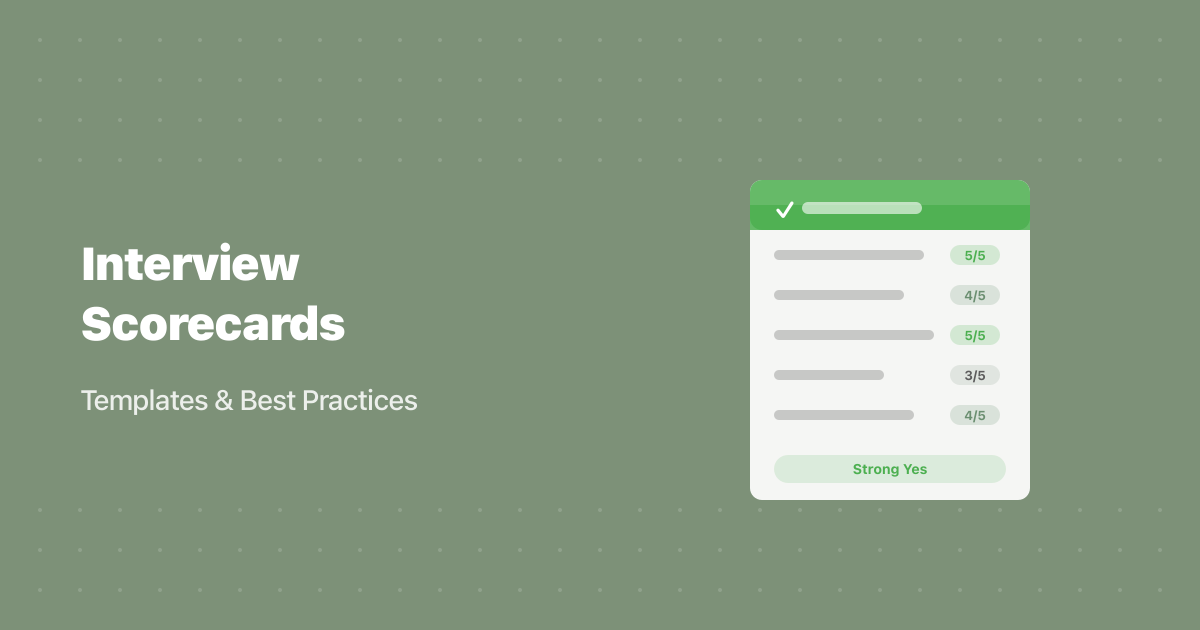
An interview scorecard is a standardized form that rates every candidate against the same job-specific competencies, using the same scale, with written evidence for each score - and teams that use them make dramatically better hires. Below you'll find five ready-to-use templates covering technical roles, behavioral interviews, leadership hiring, high-volume screening, and panel debriefs.
Why does this matter? According to Schmidt and Hunter's meta-analysis, interviews conducted without structured scoring have a predictive validity of just .20 - barely better than random selection. Add a structured scorecard with behavioral anchors, and that number jumps to .51. A follow-up study by Oh, Postlethwaite, and Schmidt (2012) found the most rigorous scoring methods push validity even higher, to .57.
Yet most teams still rely on gut feelings after interviews. SHRM Labs (2024) reports that 48% of HR managers admit biases affect their hiring decisions. And CareerBuilder research puts the number of employers who've hired the wrong person at 75% - with the U.S. Department of Labor estimating each bad hire costs up to 30% of first-year wages.
This guide covers the essential components every scorecard needs, five downloadable-style templates for different hiring scenarios, the rating scales that actually work, and how to keep your process EEOC-compliant.
TL;DR: An interview scorecard is a standardized form for rating candidates against the same job-specific competencies using a consistent scale. Structured scoring raises predictive validity from .20 to .51 (Schmidt & Hunter). This guide includes five ready-to-use templates - technical, behavioral, leadership, high-volume, and panel debrief - plus rating scale comparisons and EEOC compliance requirements for record retention.
An interview scorecard is a structured evaluation form where interviewers rate candidates on predetermined, job-specific competencies using a consistent scale. It replaces the "thumbs up, thumbs down" approach with documented evidence that makes hiring decisions defensible and comparable.
Think of it as the difference between a restaurant review that says "food was good" versus one that rates flavor, presentation, service, and value on a 1-5 scale with specific observations. The second version tells you something useful. The first doesn't.
Every effective scorecard includes these core elements:
Here's why the evidence notes matter so much: the EEOC requires employers to retain all hiring records - including interview notes and scoring tools - for a minimum of one year after the hiring decision. Federal contractors must keep records for two years. If a discrimination charge is filed, all related records must be held until final resolution, with no time limit. A scorecard with documented evidence for each rating gives your legal team something to work with. Scribbled notes on a napkin don't. Effective scorecards also require strong hiring manager collaboration - interviewers need to be calibrated on what each rating level means before the first candidate walks in.
For a complete breakdown of how structured interviews work from question design through scoring, see our guide to structured interviews.

Interviews with structured scoring reach a predictive validity of .51 compared to .20 without scoring, per Schmidt and Hunter - but the right scorecard depends on what you're evaluating. A software engineer interview needs different competencies than an executive leadership assessment. These first three templates cover the most common individual interview scenarios, built around scoring principles from the U.S. Office of Personnel Management and SHRM's structured interviewing toolkit.
Use this for engineering, data science, IT, and other roles where demonstrable technical skills are the primary evaluation criteria.
| Competency | Weight | 1 - Does Not Meet | 3 - Meets Expectations | 5 - Exceeds | Score | Evidence |
|---|---|---|---|---|---|---|
| Core technical skills | 30% | Cannot solve basic problems in the required language/framework | Solves problems competently with standard approaches | Demonstrates deep expertise, optimizes for edge cases unprompted | __/5 | [Notes] |
| System design / architecture | 25% | Cannot articulate component interactions | Designs a working system with reasonable tradeoff analysis | Proposes scalable architecture, identifies bottlenecks proactively | __/5 | [Notes] |
| Problem-solving approach | 20% | Jumps to code without clarifying requirements | Asks clarifying questions, breaks problem into steps | Identifies multiple approaches, articulates tradeoffs before choosing | __/5 | [Notes] |
| Communication | 15% | Cannot explain reasoning clearly | Explains thought process as they work | Communicates complex concepts simply, adjusts to audience | __/5 | [Notes] |
| Collaboration signals | 10% | Dismisses feedback, works in isolation | Receptive to hints, references team-based work in examples | Actively builds on feedback, cites cross-team impact in past roles | __/5 | [Notes] |
Weighted total: ___/5.0 | Overall recommendation: Definitely Not / No / Yes / Strong Yes
When to use this template: Any role where you need to separate candidates who can talk about technology from candidates who can actually build with it. The 30% weight on core technical skills ensures strong talkers don't outscore strong builders.
Use this for roles where interpersonal skills, leadership behaviors, and values alignment are as important as functional expertise. Note: it's "culture add" not "culture fit." You're looking for candidates who bring something new, not clones of your existing team.
| Competency | Weight | 1 - Does Not Meet | 3 - Meets Expectations | 5 - Exceeds | Score | Evidence |
|---|---|---|---|---|---|---|
| Conflict resolution | 25% | Avoids conflict or escalates unnecessarily | Addresses disagreements directly with specific examples | Mediates complex team conflicts, drives toward shared outcomes | __/5 | [Notes] |
| Adaptability | 20% | Rigid when plans change, cites only stable-environment examples | Adjusts approach when given new information, stays productive | Thrives in ambiguity, proactively identifies when pivots are needed | __/5 | [Notes] |
| Ownership / accountability | 20% | Blames external factors, vague on personal contribution | Takes responsibility for outcomes, clearly describes own role | Owns failures openly, describes what they'd do differently | __/5 | [Notes] |
| Cross-functional collaboration | 20% | Works only within their function, limited external examples | Partners with other teams, manages competing priorities | Builds lasting cross-team relationships, drives shared initiatives | __/5 | [Notes] |
| Growth mindset | 15% | No examples of learning from failure or seeking feedback | Describes specific learning moments and applied takeaways | Actively seeks critical feedback, implements changes, teaches others | __/5 | [Notes] |
Weighted total: ___/5.0 | Overall recommendation: Definitely Not / No / Yes / Strong Yes
When to use this template: Second or third-round interviews where technical skills have already been validated and you need to assess how the candidate works with others. Also effective for customer-facing roles, people management positions, and any role where the org chart doesn't tell you who you'll actually be working with.
Use this for director-level and above, where strategic thinking and organizational impact matter more than hands-on execution.
| Competency | Weight | 1 - Does Not Meet | 3 - Meets Expectations | 5 - Exceeds | Score | Evidence |
|---|---|---|---|---|---|---|
| Strategic vision | 25% | Focuses only on tactical execution, no long-term perspective | Articulates a clear vision for the team's next 12-18 months | Connects team strategy to company mission with measurable milestones | __/5 | [Notes] |
| Team building / talent development | 25% | No examples of developing reports or building teams | Has hired, coached, and retained strong performers | Built high-performing teams from scratch, promoted from within, measurable retention improvements | __/5 | [Notes] |
| Decision-making under ambiguity | 20% | Paralyzed without complete data, defers all decisions upward | Makes timely decisions with incomplete information, explains reasoning | Creates decision frameworks others adopt, comfortable reversing course when data shifts | __/5 | [Notes] |
| Stakeholder management | 15% | Communicates only with direct reports | Manages up and across effectively, aligns competing priorities | Influences executive decisions, builds cross-org coalitions | __/5 | [Notes] |
| Results / P&L impact | 15% | Cannot quantify past impact on business outcomes | Cites specific revenue, cost, or efficiency metrics from past roles | Drove transformational results with clear before/after data | __/5 | [Notes] |
Weighted total: ___/5.0 | Overall recommendation: Definitely Not / No / Yes / Strong Yes
When to use this template: VP, C-suite, and director-level interviews where the candidate won't be writing code or handling individual contributor tasks. The competency mix shifts from "can you do the work" to "can you build and lead teams that do the work."
The first three templates cover individual interview loops. These next two handle the bookends of most hiring processes - screening at scale and synthesizing panel feedback. Both scenarios require different scoring approaches than a standard 1-on-1 interview.
Use this for roles where you're reviewing dozens or hundreds of candidates - retail, customer service, sales, warehouse operations - and need a fast, consistent way to screen at the top of the funnel.
| Competency | Weight | 1 - No | 2 - Partial | 3 - Yes | Score |
|---|---|---|---|---|---|
| Meets minimum qualifications | Pass/Fail | Missing required credential or experience | Meets some but not all requirements | Fully qualified | __/3 |
| Schedule availability | Pass/Fail | Cannot meet required hours | Partial overlap with needs | Full availability match | __/3 |
| Communication clarity | 33% | Unclear, disorganized responses | Adequate but needs prompting | Clear, concise, professional | __/3 |
| Motivation / role fit | 34% | No clear reason for applying | Generic interest | Specific, informed reasons tied to the role | __/3 |
| Reliability indicators | 33% | Attendance/commitment concerns | Adequate history | Strong track record, specific examples | __/3 |
Total: ___/15 (advance if 10+, no pass/fail failures) | Decision: Advance / Hold / Reject
When to use this template: Phone screens and first-round interviews where you need to process candidates quickly without sacrificing consistency. The 3-point scale speeds up evaluation while the pass/fail gates ensure no unqualified candidates slip through. When you're screening at scale, pairing this scorecard with AI interview scheduling eliminates the administrative bottleneck of coordinating dozens of conversations.
Use this after a panel interview or multi-stage loop, where multiple interviewers need to compare assessments and reach a group decision.
| Area | Interviewer 1 | Interviewer 2 | Interviewer 3 | Consensus |
|---|---|---|---|---|
| Technical / functional skills | __/5 | __/5 | __/5 | __/5 |
| Problem-solving | __/5 | __/5 | __/5 | __/5 |
| Communication | __/5 | __/5 | __/5 | __/5 |
| Leadership / collaboration | __/5 | __/5 | __/5 | __/5 |
| Role fit / motivation | __/5 | __/5 | __/5 | __/5 |
Key disagreements to resolve: [Document any score gaps of 2+ points]
Red flags raised: [List concerns from any interviewer]
Group recommendation: Definitely Not / No / Yes / Strong Yes
When to use this template: Final-round debriefs where you need to synthesize input from 2-5 interviewers. The critical rule: every interviewer submits their individual scorecard before the debrief meeting. If people share scores out loud first, anchoring bias takes over and the loudest voice wins. Individual scores first, group discussion second.
For specific language to use when communicating the outcome of these debriefs to candidates, see our interview feedback templates.
A 4- or 5-point scale with behavioral anchors at each level is optimal for interview scorecards, according to the U.S. Office of Personnel Management. The specific number of points matters less than whether each level has a concrete behavioral description attached to it - that's where the predictive power comes from.
Here's how the most common scales compare:
| Scale | Points | Best For | Risk | Verdict |
|---|---|---|---|---|
| Simple Likert | 5 | Most roles; natively supported by most ATS platforms | Central tendency bias (everyone gets a 3) without anchors | Best all-around choice |
| Forced choice | 4 | Eliminating the safe "neutral" middle option | Slightly lower inter-rater reliability | Good for decisive teams |
| BARS | 4-7 | Roles with precise, observable behaviors | Time-intensive to build for each role | Highest validity |
| Pass/Fail + Likert | 3 + 5 | High-volume roles with hard requirements plus soft skills | Requires two scoring approaches in one form | Good for screening |
| Extended | 7+ | Research settings with trained raters | Cognitive overload for non-specialist interviewers | Avoid for most teams |
The takeaway? A 5-point scale with written behavioral anchors is the safest default. It's supported by every major ATS, it's intuitive enough that hiring managers don't need training to use it, and it provides enough granularity to differentiate candidates without creating false precision.
If your team consistently clusters scores around the middle (the dreaded "everyone's a 3" problem), switch to a 4-point forced-choice scale. Removing the neutral option forces interviewers to make a directional call on each competency.
Behavioral anchors are the descriptions attached to each point on your rating scale. They're what separate a useful scorecard from a number-generating exercise. Without anchors, a "4 out of 5" from one interviewer means something completely different from a "4 out of 5" from another.
Organizations that use skills-based hiring data in their decisions are 60% more likely to make a successful hire, according to LinkedIn's 2025 Future of Recruiting report. That's because skills-based evaluation forces you to define observable, testable criteria - exactly what behavioral anchors do.
Here's a framework for writing effective anchors:
Step 1: Start with the job description. Pull the 6-12 most critical competencies directly from the role's requirements. Don't invent competencies that sound important but aren't actually tested in the interview.
Step 2: Define what "great" looks like. For each competency, describe the specific behavior or response that would earn the highest score. Be concrete: "Designs a system that handles 10x current load and identifies three failure modes unprompted" is useful. "Demonstrates excellent technical ability" is not.
Step 3: Define what "unacceptable" looks like. Describe the specific response that would earn the lowest score. This anchors the bottom of your scale and prevents grade inflation.
Step 4: Fill in the middle. Write 1-2 sentence descriptions for each intermediate level. The midpoint should describe a candidate who meets but doesn't exceed expectations - someone who'd perform adequately in the role without being exceptional.
Step 5: Test with your interview team. Have two interviewers independently score the same mock candidate using your anchors. If they're more than 1 point apart on any competency, the anchor needs tightening.
Here's a worked example for a "problem-solving" competency on a 5-point scale:
| Score | Behavioral Anchor |
|---|---|
| 1 | Cannot break the problem down. Jumps to implementation without clarifying requirements. Gets stuck and cannot recover without significant help. |
| 2 | Identifies the core problem but struggles with approach. Needs multiple hints to make progress. Solution works but has obvious gaps. |
| 3 | Asks clarifying questions, outlines an approach, and arrives at a working solution. Handles the straightforward case but may miss edge cases. |
| 4 | Identifies multiple approaches, articulates tradeoffs, and selects a well-reasoned path. Solution is complete and handles most edge cases. |
| 5 | All of the above, plus: identifies non-obvious constraints, proposes optimizations unprompted, and considers how the solution scales or integrates with the broader system. |
Notice how each level builds on the previous one. There's no ambiguity about what separates a 3 from a 4. That's the whole point. This anchor structure follows the BARS (Behaviorally Anchored Rating Scale) methodology, which Oh et al. (2012) found achieves the highest predictive validity (.57) among all interview evaluation methods.
The EEOC's recordkeeping requirements (29 CFR Part 1602) require employers to retain all interview scorecards for at least one year after the hiring decision - two years for federal contractors. That alone makes scorecards your strongest defense against discrimination claims. The EEOC mandate covers all hiring records - including interview notes, scoring tools, and evaluation forms - for a minimum of one year after the hiring decision. Federal contractors must keep records for two years. If an EEOC charge is filed, all related records must be retained until the case reaches final resolution.
What does this mean in practice? Every candidate you interview generates a compliance obligation. A structured scorecard satisfies it. A vague memory of "I just didn't feel it" doesn't.
Here's what scorecards document for compliance purposes:
Without documented evaluation criteria, your legal team has no objective record to present to investigators. The EEOC routinely requests disposition data and supporting documentation when investigating hiring discrimination claims. A well-maintained scorecard archive turns a "he said, she said" situation into "here are the documented scores and the evidence behind each one."
One more compliance detail worth knowing: SHRM Labs (2024) reports that 48% of HR managers admit biases influence their hiring decisions. Scorecards don't eliminate bias entirely - but they create the structure that makes bias visible and correctable. When every interviewer has to justify their score with written evidence, the "I just liked this candidate better" reasoning gets replaced by something defensible.
For deeper strategies on how AI tools can help reduce bias throughout the hiring process, see our guide to reducing hiring bias with AI.
Scorecard adoption fails at the implementation stage, not the template stage. SHRM's structured interviewing toolkit identifies consistency as the single biggest predictor of whether scorecards improve hiring outcomes. These seven practices, drawn from SHRM's research and field-tested approaches across high-volume hiring teams, bridge the gap between having a scorecard and actually using it.
Harvard Kennedy School professor Iris Bohnet, author of What Works: Gender Equality by Design, specifically notes that scoring during and immediately after the interview neutralizes a range of cognitive biases. The longer interviewers wait, the more they rely on general impressions rather than specific observations. Set a hard deadline: scorecards are due within 30 minutes of the interview ending. Teams that enforce this rule consistently report a noticeable jump in scoring specificity - interviewers are still recalling exact candidate responses rather than general impressions like "seemed smart."
Don't rate all competencies at once in a single sweep. Evaluate one competency at a time, referring to the behavioral anchors for each. This prevents halo effect - where a strong first impression on one dimension inflates scores across all dimensions. It also prevents the horn effect, where one weak answer tanks an otherwise strong candidate.
This is non-negotiable. If one interviewer shares their assessment before others have submitted theirs, anchoring bias takes over. The first opinion shared becomes the starting point for the group discussion, and dissenting views get suppressed. Tools that collect scores independently before revealing the group results solve this automatically. Pin's interview scheduling and team coordination features help ensure every interviewer submits before the group debrief begins.
Have your interview team independently score the same mock candidate or recorded interview, then compare results. If two interviewers are more than 1 point apart on the same competency, discuss what each person observed and refine the behavioral anchors until they're specific enough to produce consistent ratings. Recruiting teams that run quarterly calibration sessions typically see inter-rater score gaps narrow from 2+ points to under 1 point within two calibration cycles - the investment pays for itself in debrief time saved alone.
Evaluation fatigue is real. Past 12 competencies, interviewers start rushing through the last few and their scores become less reliable. Focus on the competencies that actually predict success in the role, not every possible trait you could measure.
A 5/5 on "punctuality" and a 2/5 on "system design" should not average to a 3.5 for a senior engineer role. Weight the competencies that matter most for the specific position. This is where many scorecards fail - they treat every competency as equally important, which means nice-to-have traits can outvote must-have skills.
Scorecards buried in email or Slack messages fail two tests: they're not searchable for compliance purposes, and they're not comparable across candidates. Store every completed scorecard in your applicant tracking system, linked to the candidate record. This makes it easy to pull records for EEOC requests, compare candidates side by side, and identify patterns in your interview team's scoring tendencies over time.
For teams recording interviews to review alongside their scorecards, our roundup of AI note-taking tools for recruiters covers the options that integrate directly with your ATS.

Only 25% of talent acquisition professionals feel highly confident in their ability to measure quality of hire - but 61% believe AI can improve how they measure it, according to LinkedIn's 2025 Future of Recruiting report. That gap between confidence and belief is driving rapid adoption of AI-assisted interview evaluation tools.
Here's what's actually happening on the ground in 2026:
AI-generated scorecard summaries. Instead of hiring managers reading through 5 individual scorecards and trying to synthesize themes, AI now analyzes all submitted scorecards automatically to surface shared patterns, flag scoring disagreements, and highlight key candidate attributes. This cuts debrief preparation time significantly and ensures no interviewer's input gets overlooked.
Auto-populated competencies from job descriptions. Rather than building scorecard competencies from scratch for every role, AI reads the job description and suggests relevant competencies with draft behavioral anchors. The hiring manager reviews and adjusts, but the starting point is already 80% of the way there.
Interview intelligence platforms. Tools that record and analyze interviews are producing structured data alongside - or sometimes instead of - human-scored evaluations. These platforms analyze communication patterns, technical accuracy, and behavioral signals to produce standardized assessments. They're not replacing human judgment, but they're giving interviewers a second data stream to validate or challenge their own scores.
The real value of AI in interview evaluation isn't replacing the scorecard - it's making the scorecard easier to complete, harder to skip, and more consistent across interviewers. When the friction of scoring drops, completion rates go up. And complete scorecards are the entire point.
The real takeaway for recruiting teams: AI isn't replacing scorecards. It's removing the friction that makes interviewers skip them. When scoring takes 2 minutes instead of 10, completion rates go up - and complete scorecards are the entire point.
CareerBuilder research shows 75% of employers have hired the wrong person - and many of those bad hires trace back to scorecard implementation mistakes rather than a lack of scorecards entirely. Here are the five most damaging ones:
Mistake 1: Using the same scorecard for every role. A generic "communication, teamwork, problem-solving" scorecard tells you nothing about whether a candidate can do the specific job you're hiring for. Each role needs competencies pulled from its actual requirements. A sales development rep scorecard should weight objection handling and pipeline generation. A data engineer scorecard should weight SQL optimization and data pipeline architecture. One-size-fits-all scorecards produce one-size-fits-no-one results.
Mistake 2: Skipping the behavioral anchors. A scorecard without anchors is just a spreadsheet of numbers. When "3 out of 5" means "average" to one interviewer and "good enough" to another, the scores aren't comparable. Anchors are the work. The scale is just a container.
Mistake 3: Allowing verbal debriefs before scores are submitted. This is the single biggest source of score contamination. When a senior interviewer says "I thought she was fantastic" before others have submitted their ratings, everyone else's scores shift upward. Independent scoring first, group discussion second - every time.
Mistake 4: Treating all competencies as equally weighted. If your scorecard has 8 competencies with equal weight, a candidate who scores 5/5 on "timeliness" and 1/5 on "core technical skills" gets the same average as someone who scores 3/5 across the board. Weight the competencies that actually predict success in the role. A 30% weight on the make-or-break skill and 5% on nice-to-haves produces much more useful aggregate scores.
Mistake 5: Completing scorecards days after the interview. Research on memory decay is clear: within 24 hours, interviewers lose the specific details that make their scores meaningful. What remains are general impressions - exactly the kind of fuzzy, bias-prone thinking that scorecards are designed to prevent. Set a hard deadline. Scorecards due within 30 minutes is ideal. Same day is the minimum.
Only 25% of talent acquisition professionals feel highly confident measuring quality of hire, according to LinkedIn's 2025 Future of Recruiting report. Four metrics tell you whether your scorecard system is actually improving outcomes:
Inter-rater reliability. Have multiple interviewers independently score the same candidate and compare their ratings. If interviewers consistently agree within 1 point on each competency, your behavioral anchors are working. If scores diverge by 2+ points regularly, your anchors need tightening or your team needs calibration.
Quality of hire correlation. Track whether candidates with high scorecard ratings actually become high performers on the job. After 6 and 12 months, compare scorecard scores to performance review ratings. If there's no correlation, your competencies aren't measuring what matters. This is the ultimate test - and LinkedIn's 2025 data showing that only 25% of TA professionals feel confident measuring quality of hire suggests most teams aren't running this analysis.
Scorecard completion rate. What percentage of interviews result in a completed scorecard? Anything below 90% means interviewers are skipping the process, which undermines consistency and creates compliance gaps. Track completion by interviewer to identify who needs coaching or process improvements.
Time-to-debrief. How quickly after the interview does the team reach a consensus decision? Effective scorecards should speed this up because the evidence is already documented. If debriefs are still taking 45 minutes of discussion for each candidate, the scorecards aren't providing enough structure.
Rich Rosen, founder of Cornerstone Search Associates and a Forbes Top-50 Recruiter in America, puts the value of structured hiring processes bluntly: "Absolutely money maker for recruiters... in 6 months I can directly attribute over $250K in revenue to Pin." When your sourcing feeds qualified candidates into a well-structured evaluation process, the downstream impact on placement speed and revenue is measurable.
Pin's AI scans 850M+ profiles to find qualified candidates before your scorecard process even begins - start sourcing free.
Every interview scorecard needs 6-12 job-specific competencies, a rating scale (4 or 5 points is optimal), behavioral anchors defining each score level, a notes section for evidence, and an overall hire/no-hire recommendation. According to OPM guidance, each competency should map directly to the role's requirements and be weighted by importance.
Scorecards force interviewers to evaluate every candidate on the same criteria using the same scale, which limits the influence of gut reactions and first impressions. SHRM Labs (2024) reports that 48% of HR managers admit biases affect their hiring decisions. Structured scoring with behavioral anchors makes those biases visible and correctable by requiring evidence for each rating.
Research and practitioner consensus converge on 4-5 points as the optimal range. A 5-point scale offers enough granularity to differentiate candidates while remaining intuitive for untrained interviewers. The U.S. Office of Personnel Management endorses 3-5 point scales with behavioral anchors at each level. If your team tends to cluster around the middle score, a 4-point forced-choice scale eliminates the safe neutral option.
The EEOC requires all hiring records, including interview scorecards, to be retained for a minimum of 1 year after the hiring decision (29 CFR Part 1602). Federal contractors must keep records for 2 years. If a discrimination charge is filed, records must be held until final resolution with no time limit. Store completed scorecards in your ATS, not in email threads or personal files.
Not yet - but AI is making scorecards more consistent and easier to complete. According to LinkedIn's 2025 Future of Recruiting report, 61% of TA professionals believe AI will improve quality-of-hire measurement. Current AI tools auto-generate scorecard competencies from job descriptions, summarize multi-interviewer assessments, and flag scoring disagreements - but the final evaluation still requires human judgment.
Build a stronger interview pipeline with Pin's AI sourcing and scheduling - start free