What Is a Panel Interview? How to Run One Fairly (2026)
Panel interviews put 2-5 evaluators in one session. Structured panels reach .57 predictive validity and .74 interrater reliability. 7-step fairness guide.
Panel interviews put 2-5 evaluators in one session. Structured panels reach .57 predictive validity and .74 interrater reliability. 7-step fairness guide.
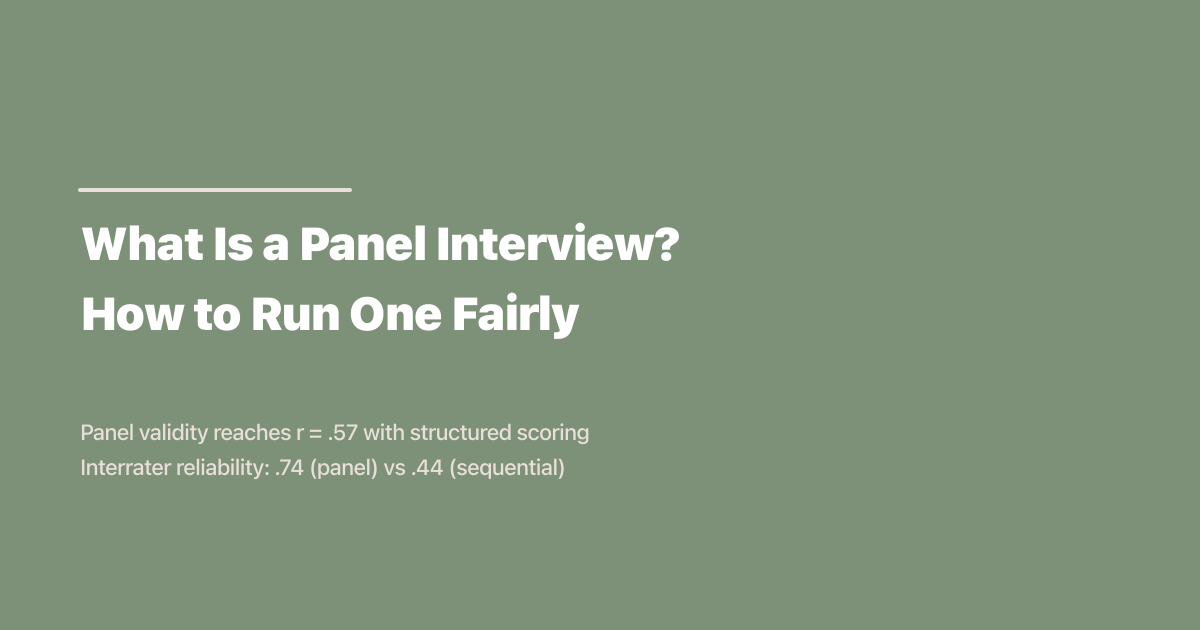
A panel interview is an interview format where two to five interviewers evaluate a single candidate in one session, each assessing different competencies using the same scoring criteria. When structured correctly, it's one of the most predictive and bias-resistant hiring methods available - reaching a predictive validity of r = .57, according to Huffcutt and Arthur's meta-analysis in the Journal of Applied Psychology.
But "structured correctly" is doing a lot of work in that sentence. A poorly run panel can amplify groupthink, intimidate candidates, and produce worse outcomes than individual interviews. And the stakes are higher than most teams realize: according to iCIMS's 2024 Talent Experience Report, 51% of people are less likely to become or remain a consumer of a brand after a negative application or interview experience. A bad panel doesn't just cost you a candidate - it costs you customers. This guide covers the research behind why panels work, the step-by-step process for running a fair one, and the mistakes that turn a strong evaluation method into a liability.
TL;DR: A panel interview places 2-5 interviewers in one session with a candidate. When structured with standardized questions, independent scoring, and a diverse panel, it reaches .57 predictive validity and .74 interrater reliability (Huffcutt, 2013). The key: every panelist scores independently before any group discussion begins.
Not every multi-person interview is a panel interview. The distinction matters because each format produces different data, introduces different biases, and demands different logistics. Here's how the three most common multi-person formats compare:
| Format | Structure | Best For | Key Risk |
|---|---|---|---|
| Panel interview | 2-5 interviewers, 1 candidate, same session | Cross-functional evaluation, senior roles, fairness-critical positions | Groupthink if panelists don't score independently |
| Serial (sequential) interview | 1 interviewer at a time, multiple rounds | Deep-dive on different competencies per round | Inconsistency between interviewers; candidate fatigue |
| Group interview | 1-2 interviewers, multiple candidates at once | High-volume hiring, retail, customer-facing roles | Introverted candidates get overshadowed |
The critical advantage of a panel format is that every evaluator observes the same answers at the same time. In serial interviews, candidate responses shift between rounds - different energy levels, different question framings, different rapport dynamics. A panel eliminates that variability. According to Huffcutt's 2013 meta-analysis on interview reliability, panel interviews produce an interrater reliability of .74, compared to .44 for sequential interviews conducted by different interviewers. That's the difference between evaluators mostly agreeing on candidate quality and barely agreeing at all. A more recent 2025 meta-analysis by Wingate et al., drawing on 37 studies and 30,646 participants, reinforces this: medium-structure panels reach .73 interrater reliability, while highly structured panels reach .78. The more rigorous the process, the more reliably panelists agree on what they saw.
Does the panel approach take more coordination? Yes. Is it worth it? For any role where hiring the wrong person costs more than a few weeks of salary, the answer is clearly yes.
The research on interview validity isn't ambiguous. Huffcutt and Arthur (1994) categorized interviews into four structure levels and measured how well each predicted actual job performance. The pattern is stark: the more structure you add, the better the interview predicts who'll succeed on the job - and adding a panel format to the highest structure level pushes validity to its ceiling.

What's driving that improvement? Two things. First, multiple evaluators cancel out individual biases - one interviewer's blind spots get offset by another's perspective. Second, the structured format forces each panelist to evaluate against job-relevant competencies rather than personal impressions. A 2025 meta-analysis by Wingate et al. in the International Journal of Selection and Assessment confirmed that structured interviews maintain similar validity across both task performance and contextual performance - meaning the format works whether you're assessing hard skills or soft skills.
For a deeper look at implementing structured scoring, see our guide on structured interviews and why they work.
Bias doesn't disappear when you add more people to an interview room. But a well-structured panel makes bias harder to act on - and easier to catch. According to a 2022 peer-reviewed study in Academic Medicine, unstructured interviews produce approximately a 0.25 standard deviation scoring disadvantage for Black and Hispanic candidates compared to white candidates. As interview structure increases, that gap narrows significantly.
Here's why panels help, specifically:
The 2024 CandE Benchmark Research from ERE, which surveyed over 230,000 candidates, found that companies running the most structured interview processes showed 21% higher candidate-perceived fairness in interviews and 36% higher fairness perception in assessments. Candidates can tell when a process is designed to be fair - and they respond accordingly.
For more on eliminating bias from your hiring process, see our guide on reducing hiring bias with AI.
A fair panel doesn't happen by accident. It requires deliberate design at every stage - from who sits on the panel to how scores are collected after the session ends. The U.S. Office of Personnel Management validates this framework: structured interviews are legally defensible when tied to competencies identified through job analysis, scored using trained evaluators with anchored rating scales.
Here's the process that turns a panel from a conference-room ambush into a genuine evaluation tool:
Before scheduling a single interview, identify the 4-6 core competencies the role actually requires. Not "nice to haves" - the skills and behaviors that separate strong performers from weak ones in this specific position. The NACE 2026 Job Outlook Survey found that 87% of employers using skills-based hiring now use structured interviews during the interviewing stage. Competency-first design is the foundation - and it's not yet the default. The 2024 CandE Benchmark Research from ERE found that only two-thirds of employers deliver fully structured interview processes. Running a properly designed panel puts you ahead of a third of the market before the first question is asked.
Each panelist should own 1-2 competency areas. Typical role assignments:
The moderator role is non-negotiable. Without one, the most assertive panelist dominates questioning and the interview drifts off-script. Who moderates matters too - it should be someone who won't be making the final hiring decision, so they can focus on process quality rather than evaluation.
Each competency gets 2-3 questions: one behavioral ("Tell me about a time when..."), one situational ("How would you handle..."), and optionally one technical or case-based. Every candidate for the same role hears the same questions in the same order.
Avoid open-ended warmups like "tell me about yourself" - they waste time and introduce rapport bias (extroverted candidates immediately get an advantage). Start with the first competency question and set expectations upfront: "We have six questions across four areas. Each panelist will ask about their specialty."
Use a 1-5 scale with written descriptions for each level. A "3" on problem-solving shouldn't mean "average" - it should describe a specific behavior: "Identifies the core problem and proposes one viable solution, but doesn't anticipate edge cases or second-order effects."
For templates and examples, our interview feedback templates cover scoring rubrics across multiple hiring scenarios.
Fifteen minutes before the candidate arrives, align on:
This is the step most teams skip - and skipping it undermines the entire point of the panel format. After the candidate leaves, each panelist records their scores silently and independently before anyone speaks. No hallway conversations, no quick "what did you think?" huddles.
Why? Because the moment a senior leader says "I thought they were strong," every other panelist's scores shift upward. Social psychologists call this conformity bias, and it's devastating in small groups. Independent scoring is the only reliable countermeasure.
Once all scores are submitted, the moderator reveals them simultaneously - either on a shared screen or by reading them aloud. The debrief follows this structure:
Speed matters here too. The 2024 CandE Benchmark Research found that 64% of candidates at top-performing companies received an offer letter within one week of their final interview. A fast, structured debrief is what makes that timeline achievable - drawn-out deliberations drag out the process and give competing employers time to move first.
Panel composition isn't a checkbox exercise - it directly affects both evaluation quality and candidate perception. The Greenhouse 2024 Candidate Experience Report, which surveyed 2,900+ candidates across the US, UK, and EU, found that 20% of candidates rejected job offers specifically because of poor interview experiences. Beyond rejection risk, the same research makes clear that a majority of candidates view a diverse interview panel as fundamental to better hiring decisions. When candidates see a panel that reflects the company's stated values, they're more likely to accept an offer - and less likely to withdraw mid-process.

The data on organizational performance reinforces this. McKinsey's "Diversity Matters Even More" report (2023), analyzing 1,265 companies across 23 countries, found that companies in the top quartile for gender diversity on executive teams are 39% more likely to outperform on profitability. A diverse panel isn't just better for candidates - it's better for the business evaluating them.
Practical composition guidelines:
Pin's AI handles the scheduling complexity that panels create - syncing multiple interviewers' calendars, finding shared open slots, and sending confirmations automatically. For teams running 10+ panels per week, that coordination alone saves hours of recruiter time.
The Greenhouse 2024 report found that 20% of candidates rejected job offers specifically because of a poor interview experience, and 54% reported encountering discriminatory questions during interviews. Panel format doesn't automatically prevent these problems - in fact, a disorganized panel can make them worse.
Here are the five most common failures:
This is the most damaging mistake and the most common. The moment panelists discuss impressions before recording their scores, you've converted your panel into a single-evaluator interview with the loudest person's opinion as the anchor. It defeats the entire statistical advantage of multiple independent assessments.
Fix: Use a digital scorecard system or printed rubrics collected before anyone speaks. No exceptions.
Without a designated moderator, panels drift into unstructured conversations. One panelist dominates. Time management collapses. The candidate gets three questions about culture fit and zero about the role's core technical requirements.
Fix: The recruiter or a neutral facilitator manages time, transitions, and question order. They don't evaluate - they protect the process.
Five or six interviewers firing questions at one candidate isn't thorough - it's overwhelming. The Cronofy 2024 Candidate Expectations Report found that 42% of candidates withdrew from hiring processes because scheduling took too long. Every additional panelist multiplies scheduling complexity and drags out the process.
Fix: Cap panels at four people. If more stakeholders need input, have them review recorded sessions or interview notes afterward.
A panel of four people with the same background, seniority, and department doesn't provide multiple perspectives - it provides one perspective amplified four times. Research consistently shows homogeneous groups make faster decisions but worse ones, because nobody challenges shared assumptions.
Fix: Vary department, seniority, and background. Cross-functional representation isn't optional for panels that evaluate fairly.
If panelists haven't been trained on the rubric, they'll each interpret "strong problem-solving" differently. One interviewer's "3" is another's "5." The scoring data becomes noise rather than signal.
Fix: Run a 15-minute calibration session before the panel's first interview. Review the rubric together, discuss what each score level looks like with examples, and practice scoring one hypothetical response as a group.
The biggest practical barrier to panel interviews isn't the evaluation methodology - it's the coordination overhead. Finding a 60-minute window where three to four interviewers and a candidate are all available, sending prep materials, collecting independent scores, and generating debrief summaries adds up fast. With the average US time-to-fill already at 44 days according to SHRM's 2025 Recruiting Benchmarking Report, adding logistical friction to your interview process isn't an option.
AI recruiting tools address this in three ways:
As Rich Rosen, Executive Recruiter at Cornerstone Search, puts it: "Absolutely money maker for recruiters... in 6 months I can directly attribute over $250K in revenue to Pin." That kind of pipeline efficiency means your panels evaluate stronger candidates from the start.
For a full breakdown of AI tools that support the interview process, see our roundup of the best AI recruiting tools in 2026.
Candidates often find panels intimidating - and that anxiety can suppress their actual performance, giving you an inaccurate read. The Greenhouse 2024 report found that 54% of candidates encountered questions they perceived as discriminatory during interviews. Even when those questions aren't intentionally biased, the perception damages your employer brand and candidate pipeline.
How to make the experience fair and comfortable without softening the evaluation:
For more strategies on creating a positive interview process, our guide to improving candidate experience covers the full hiring funnel.
Automate your interview scheduling with Pin's AI - free to start
Three to four panelists is the most effective range. Research from Huffcutt's 2013 meta-analysis shows panels of this size achieve .74 interrater reliability while remaining manageable for scheduling. Two panelists limit perspective diversity, and five or more overwhelm candidates and create coordination bottlenecks.
A panel interview has multiple interviewers evaluating one candidate. A group interview has one or two interviewers evaluating multiple candidates simultaneously. Panel format provides deeper individual assessment - group format is designed for high-volume screening where you need to compare candidates directly against each other in real time.
They can, if the panel isn't managed properly. The Greenhouse 2024 report found 20% of candidates rejected offers due to poor interview experiences. Sharing the panel format, names, and competency areas in advance reduces candidate anxiety and produces more accurate evaluations. The goal is assessment accuracy, not stress testing.
Independent scoring before any group discussion is the single most effective countermeasure. Each panelist records their scores against the rubric before the debrief begins. The moderator reveals all scores simultaneously, then facilitates discussion only on competencies where scores diverge by two or more points. This preserves the statistical independence that makes panels more reliable than individual interviews.
Yes, when structured correctly. The U.S. Office of Personnel Management confirms that structured interviews are legally defensible when questions are derived from job analysis, scored with anchored rating scales, and documented thoroughly. The panel format adds an additional layer of defense because multiple evaluators provide corroborating assessments, reducing the appearance of individual bias.
Schedule panel interviews faster with Pin's AI recruiting assistant - start free