Recruitment Funnel Benchmarks 2026: Conversion Rates by Stage
Only 3% of applicants reach interviews and 0.5% get hired. 2026 recruitment funnel benchmarks by stage, industry, and channel - 10M+ applications analyzed.
Only 3% of applicants reach interviews and 0.5% get hired. 2026 recruitment funnel benchmarks by stage, industry, and channel - 10M+ applications analyzed.
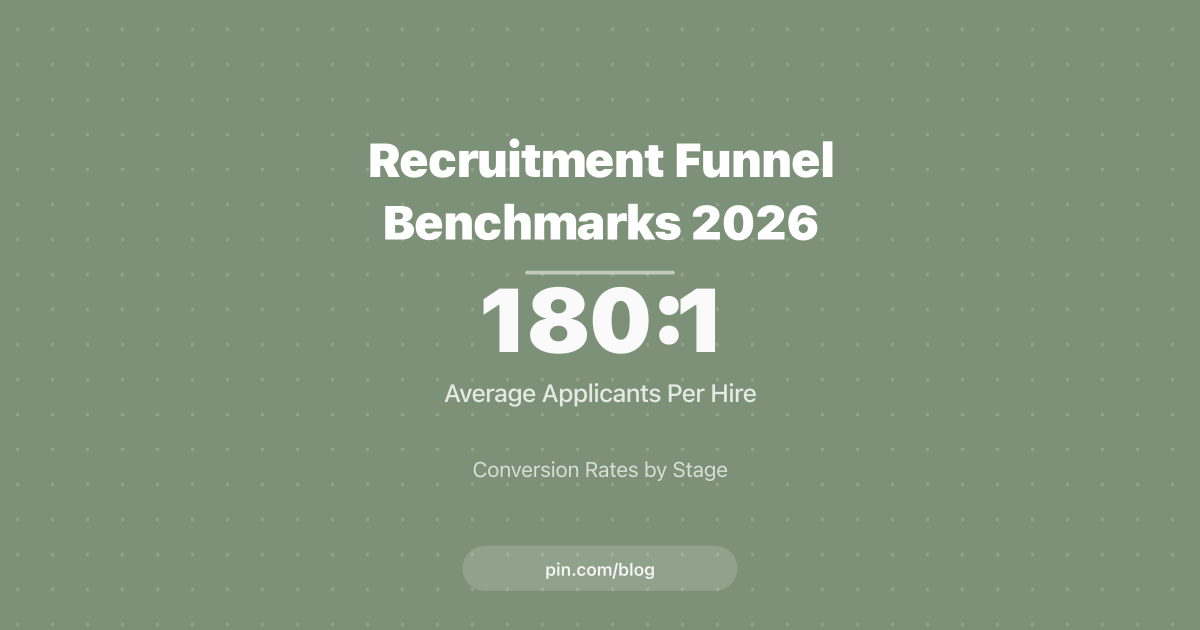
The average recruitment funnel converts roughly 3% of applicants to interviews and less than 1% to hires, based on CareerPlug's 2025 Recruiting Metrics Report analyzing over 10 million applications. That means for every 180 people who apply, one person gets the job. The rest drop out - or get screened out - at some stage along the way.
But averages only tell part of the story. Tech roles require 191 applicants per hire. Healthcare needs just 47. And the channel candidates come through changes everything: sourced candidates convert at measurably higher rates than inbound applicants. This guide breaks down the real conversion rates at every recruitment funnel stage, compares benchmarks across industries, and identifies where your funnel is most likely leaking qualified talent.
TL;DR: The average recruitment funnel converts 6% of job views to applications, 3% of applicants to interviews, and 27% of interviewees to hires - roughly 1 hire per 180 applicants (CareerPlug, 2025). Tech roles need 191 applicants per hire while healthcare needs only 47. Sourced candidates convert at far higher rates than inbound applicants.
The recruitment funnel narrows fast. According to CareerPlug's 2025 report (60,000+ companies, 10 million+ applications), the average conversion at each stage is:
What jumps out is where the biggest drop-off happens. The screening stage eliminates 97% of applicants before they ever speak with a human. That's not necessarily a problem - many of those applicants are unqualified spray-and-pray submissions. But it does mean that if your screening process has blind spots, you're losing qualified candidates before they ever get a shot.

The funnel has also gotten more competitive over time. Applications per hire have tripled since 2021, according to Ashby's 2025 Talent Trends Report (31 million applications, 95,000 jobs). More applicants per role means lower conversion rates at every stage - even when your hiring process hasn't changed. Understanding these benchmarks helps you identify whether a bottleneck is a you problem or an industry-wide shift.
The click-to-apply stage loses 94% of job viewers, screening cuts another 97% of applicants, and only 27% of interviewed candidates get hired (CareerPlug, 2025). Each stage has its own dynamics, failure modes, and benchmark range. Here's what the data says at each transition point.
The average click-to-apply rate sits at 6%, per CareerPlug's 2025 data. That means 94 out of every 100 people who view a job posting decide not to apply. Appcast's 2025 Recruitment Marketing Benchmark Report (379 million clicks, 30 million applications) shows a similar figure at 6.1%, noting a 35% increase in apply rates during 2024 - likely driven by easier mobile applications and one-click apply buttons.
What kills apply rates? Long application forms top the list. Every additional field beyond the basics drops completion by 5-10%. Job descriptions that read like internal requirements documents rather than candidate-facing content also underperform. The fix isn't lowering standards - it's reducing friction for qualified people who don't want to spend 45 minutes filling out fields your ATS could auto-populate.
Only 3% of applicants make it to an interview, according to CareerPlug's analysis. Ashby's 2025 data paints a more granular picture: interview-to-offer rates sit at roughly 7% for technical roles and 9% for business roles, meaning the funnel tightens further even after the initial screen.
The application-to-interview stage is where volume creates the most pain. Recruiters are now managing an average of 93% more applications than they were in 2021, per Ashby's report, while team headcounts haven't kept pace. That mismatch forces rushed reviews, keyword-based filtering, and qualified candidates getting passed over because no human had time to actually read their resume.
This is the stage where AI makes the biggest measurable difference. Automated screening tools can process hundreds of applications against nuanced criteria in minutes. That doesn't mean rubber-stamping everyone through - it means spending review time on the 15% who genuinely match instead of manually sorting through the 85% who don't.
About 27% of candidates who interview ultimately get hired, according to CareerPlug. For college recruiting specifically, NACE's 2025 benchmarks put the interview-to-offer rate at 47.5% - nearly double the general average because campus pipelines are more pre-filtered.
The gap between those numbers reveals something important: how selective your pre-interview screening is directly determines your interview-to-offer efficiency. Teams that screen aggressively upfront (lower application-to-interview rates) tend to have higher interview-to-offer rates because they've already filtered out poor fits.
Interview volume is part of the problem. Hiring teams now conduct 42% more interviews per hire than in 2021, per Ashby's data. More interview rounds mean more candidate fatigue, more scheduling overhead, and more opportunities for top candidates to accept a competing offer while you're still scheduling round four. Does your process actually need five rounds? Or has interview inflation become a crutch for indecisive hiring committees?
Offer acceptance rates vary widely by industry, but NACE's benchmark data puts the college recruiting offer-to-acceptance rate at 69.3%. Industry benchmarks trend higher for general hiring, typically ranging from 77% to 92% depending on the sector.
Manufacturing leads with acceptance rates above 90%, while tech and healthcare lag closer to 77%. Why the gap? Competitive counter-offers. Tech candidates often receive multiple offers simultaneously, and healthcare professionals have extreme optionality in the current market. Speed matters here - Cronofy's 2024 Candidate Expectations Report (12,000 candidates across 7 countries) found that 42% of candidates withdraw from recruiting processes when interview scheduling takes too long.
That stat alone should reshape how you think about funnel velocity. Nearly half your offer-stage losses may not be about compensation at all. They're about how long it took you to get there.
The 180-applicants-per-hire average masks enormous industry variation. Technology roles require more than four times the applicant volume that healthcare roles do, according to Pinpoint HQ's Q4 2025 industry benchmarks.

Technology's 191 applicants per hire is partly an AI-application effect. Easy-apply tools and AI-generated cover letters have flooded tech job postings with high volumes of low-fit candidates. CareerPlug's data shows automotive roles are even higher at 234 applicants per hire, while education and childcare sit at just 57.
Healthcare's low ratio (47 applicants per hire) reflects the opposite dynamic: chronic talent shortages mean fewer applicants per role, but those who apply tend to be more qualified. The conversion rate at each stage is higher because the applicant pool is more targeted from the start.
What should you do with these numbers? Compare your funnel against your industry, not the global average. If you're a tech company getting 191 applicants per hire and complaining about volume, you're actually right at the benchmark. But if you're a healthcare recruiter seeing 150+ applicants per role, something unusual is happening - either your job postings are too broad, you're attracting out-of-scope applicants, or your employer brand is pulling from adjacent industries.
The median U.S. time to fill is 45 days, according to SHRM's 2025 Benchmarking Report. But that number shifts by 20+ days depending on your industry and role complexity. Pinpoint HQ's Q4 2025 data shows the median ranges from 42 days in manufacturing to 48 days in technology.

Financial services and technology are the slowest industries to fill roles, both averaging 48-49 days. That's partly structural - regulated industries have compliance-driven interview steps, and tech roles often involve multi-stage technical assessments. Ashby's 2025 data confirms that technical roles take a median of 41 days to hire versus 32 days for business roles, with 75% of technical positions filled within 60 days.
Manufacturing is faster at 42 days despite high role complexity, largely because hiring processes in manufacturing tend to be more streamlined - fewer interview rounds, less committee decision-making, and clearer skill requirements that reduce deliberation.
Average time-to-hire has increased 24% since 2021, climbing from 33 to 41 days (Ashby, 2025). The primary driver isn't longer individual interview stages - it's more interview rounds per hire. Teams now average 42% more interviews per hire than three years ago. That's a structural inflation problem, not a scheduling problem. Though scheduling remains a bottleneck too: 42% of candidates abandon processes with slow scheduling, per Cronofy's 2024 report.
Applications per hire have tripled since 2021, according to Ashby's 2025 Talent Trends Report (31 million applications, 95,000 jobs). That single data point explains much of the pain hiring teams feel today. The recruitment funnel in 2026 looks nothing like it did five years ago - every meaningful metric has shifted, and not in recruiters' favor.
Here's how the key funnel metrics have shifted:
The net result? Recruiters are processing more volume for less output. The funnel has gotten wider at the top and narrower in the middle, with screening as the choke point. Teams that haven't adapted their screening processes - or haven't added AI to handle the volume increase - are stuck doing 2021 work at 2026 volumes. That math doesn't work. Something has to give, and for most teams, it's either quality (rushing through screens) or speed (letting good candidates wait too long).
The one bright spot: candidate experience has become a genuine competitive advantage. As funnels get more crowded and slower, the teams that move fastest and communicate best win the best talent - regardless of industry. The teams still relying on manual processes are watching their best candidates accept offers elsewhere while round three of internal deliberation continues.
Not all candidates enter the funnel through the same door, and the door they use predicts their conversion rate at every subsequent stage. Sourced candidates - those proactively identified and contacted by recruiters - consistently convert at higher rates than inbound applicants who apply through job boards. According to LinkedIn's 2025 Future of Recruiting report, teams using AI-assisted sourcing and messaging are 9% more likely to make a quality hire, and the advantage compounds across every funnel stage.
Why the gap? Three reasons. First, sourced candidates are pre-vetted before they even enter the funnel. A recruiter has already evaluated their profile against the role requirements. Second, sourced candidates tend to be passive - they weren't mass-applying to 50 jobs, so their intent is more focused. Third, the personalized outreach that brings sourced candidates into the funnel creates a relationship from day one, making them more likely to stay engaged through multiple interview rounds.
Referrals convert at even higher rates. Referred candidates have already been pre-qualified by someone who understands both the role and the person, which means they enter the funnel further along than a cold applicant. Internal mobility - filling roles with existing employees - converts highest of all. An internal candidate has already been vetted, has institutional knowledge, and faces almost no ramp-up friction.
The problem? Most teams still source the majority of their hires from inbound channels. Job boards generate the highest application volumes but the lowest conversion rates. Meanwhile, direct sourcing and referrals - the channels with the best funnel performance - remain underinvested. Getting your channel mix right might matter more than optimizing any single funnel stage.
The practical implication? If your funnel metrics look worse than benchmarks, check your channel mix before blaming your process. A team that relies 90% on job board applicants will always have lower stage-by-stage conversion rates than a team running active sourcing campaigns. The funnel isn't broken - it's being fed the wrong input. Pin's AI scans 850M+ profiles to find pre-qualified candidates who match your specific criteria - see how sourced candidates improve your funnel.
According to LinkedIn's 2025 Future of Recruiting report, 37% of organizations are now actively integrating generative AI into their hiring process, up from 27% the prior year. Teams using AI-assisted messaging are 9% more likely to make a quality hire. But the bigger impact is on funnel velocity and conversion rates at specific stages.
AI affects each funnel stage differently:
Sourcing (top of funnel): AI sourcing tools don't just find more candidates - they find better-fit candidates. Instead of posting a job and waiting for 180+ inbound applicants (97% of whom won't make it past screening), AI identifies profiles that match your requirements before anyone applies. That fundamentally changes the funnel shape: fewer total entries, but higher conversion at every stage.
Screening (biggest bottleneck): This is where AI delivers the most measurable ROI. Manual screening of 180 applicants per role takes hours. AI screening takes minutes and can evaluate against more nuanced criteria than keyword matching alone. The result isn't just faster - it's more accurate, catching qualified candidates that keyword filters would miss.
Interview scheduling (hidden leak): Remember that 42% candidate withdrawal rate when scheduling takes too long? Automated scheduling eliminates the three-email-back-and-forth that adds days to each funnel transition. That alone can recover a significant portion of late-stage drop-offs.
Outreach (response rates): AI-personalized outreach consistently outperforms templated messages. Pin's automated outreach delivers a 48% response rate across email, LinkedIn, and SMS - well above the industry average for recruiter outreach. Higher response rates mean more candidates entering the funnel from sourced channels, which converts better at every subsequent stage.
The compounding effect matters. Improving conversion by even 5% at each stage of a five-stage funnel sharply reduces the number of candidates you need at the top. A team that needs 180 applicants per hire with manual processes might need only 80-90 with AI handling sourcing, screening, and scheduling. Pin users fill positions in approximately two weeks - compared to the 45-day SHRM median.
As Fahad Hassan, CEO of Range, put it after using Pin: "Within just two weeks of using the product, we hired both a software engineer and a financial planner. The speed and accuracy were unmatched." That's what funnel compression looks like in practice - fewer wasted steps, faster transitions between stages, and higher conversion at every point.
Knowing the industry averages is only useful if you can compare them to your own numbers. Here's a practical framework for benchmarking your recruitment funnel.
Here's a quick reference table of the benchmarks covered in this article. Print it, pin it to your ATS dashboard, or share it with your hiring manager - these are the numbers your funnel should be compared against.
| Metric | Benchmark | Source |
|---|---|---|
| Click-to-apply rate | 6% | CareerPlug, 2025 |
| Application-to-interview rate | 3% | CareerPlug, 2025 |
| Interview-to-hire rate | 27% | CareerPlug, 2025 |
| Interview-to-offer rate (tech) | ~7% | Ashby, 2025 |
| Interview-to-offer rate (business) | ~9% | Ashby, 2025 |
| Offer acceptance rate (general) | 69-92% | NACE, 2025 |
| Offer acceptance rate (college) | 69.3% | NACE, 2025 |
| Overall applicants per hire | 180 | CareerPlug, 2025 |
| Median time to fill (U.S.) | 45 days | SHRM, 2025 |
| Median cost per hire | $1,200 | SHRM, 2025 |
For teams tracking cost-per-hire alongside funnel metrics, the combination is powerful. SHRM's 2025 data puts the median cost per non-executive hire at $1,200 and executive hires at $10,625. When you know both your conversion rates and your cost at each stage, you can calculate exactly where in the funnel you're wasting money.
The average applicant-to-hire ratio is 180:1 across all industries, according to CareerPlug's 2025 report analyzing 10 million+ applications. However, this varies significantly: tech roles average 191 applicants per hire while healthcare averages 47 (Pinpoint HQ, Q4 2025). A "good" ratio depends on your industry - compare against your sector benchmarks, not the global average.
Approximately 3% of applicants receive interview invitations, per CareerPlug's 2025 Recruiting Metrics Report. That means 97 out of 100 applicants are screened out before speaking with anyone on the hiring team. Sourced candidates bypass much of this filtering since recruiters have already evaluated their profiles before outreach, which is why active sourcing produces higher interview rates than inbound applications.
The median U.S. time to fill is 45 days, according to SHRM's 2025 Benchmarking Report. Technology and financial services roles take longest at 48-49 days, while manufacturing averages 42 days (Pinpoint HQ, Q4 2025). Time-to-hire has increased 24% since 2021, driven largely by 42% more interviews per hire. AI recruiting tools like Pin cut this to approximately two weeks by automating sourcing, screening, and scheduling.
Sourced candidates convert at 4-8x the rate of inbound applicants because they're pre-vetted before entering the funnel. A recruiter has already matched their profile against role requirements, so they pass screening and interview stages at much higher rates. Sourced candidates also tend to be passive job seekers with less competition from simultaneous applications, resulting in higher offer acceptance rates and better quality of hire.
Offer acceptance rates range from 69% to 92% depending on context and industry. NACE's 2025 benchmarks show a 69.3% acceptance rate for college recruiting. Industry data shows manufacturing leads at 90%+ acceptance while technology and healthcare lag at roughly 77%. The biggest factor in acceptance rates isn't compensation - it's speed. Cronofy's 2024 data shows 42% of candidates withdraw from slow-moving processes before an offer is even made.
Improve your funnel conversion rates with Pin's AI recruiting platform