Talent Sourcing Strategy: Build a Repeatable Pipeline (2026)
Build a talent sourcing strategy that fills roles faster. Sourced candidates convert at 4x the rate of inbound applicants (Gem, 2026). 7-step framework inside.
Build a talent sourcing strategy that fills roles faster. Sourced candidates convert at 4x the rate of inbound applicants (Gem, 2026). 7-step framework inside.
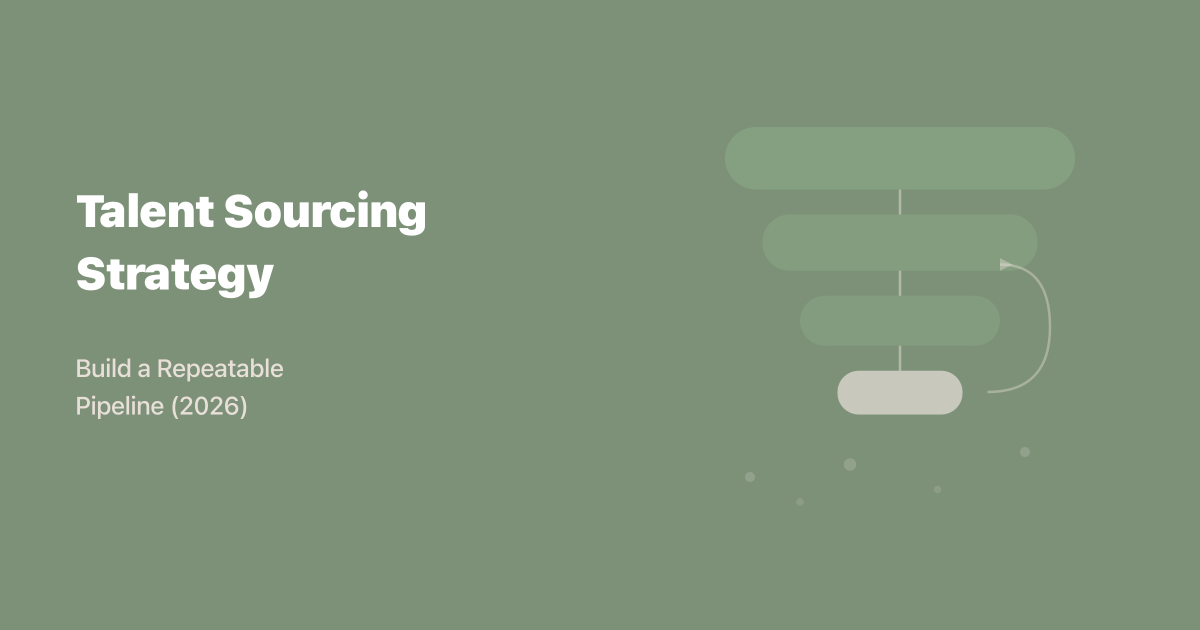
A talent sourcing strategy is a structured, repeatable system for finding, engaging, and converting qualified candidates before they apply to your roles. It's the difference between scrambling to fill every req from scratch and working from a warm pipeline that delivers hires in days instead of weeks. Sourced candidates convert to hires at 4x the rate of inbound applicants, according to Gem's 2026 Recruiting Benchmarks Report, which analyzed 165 million applications and 1.2 million hires. Yet most teams still rely on job postings and hope for the best.
That approach doesn't scale. Recruiting headcount has dropped 14% since 2021 while applications per recruiter are up 93%, according to the same Gem report. Fewer people are doing more work, and the teams winning aren't just working harder - they're working from a system. This guide breaks down a 7-step sourcing strategy framework that you can build once and run continuously, regardless of your team size or hiring volume.
TL;DR: A repeatable sourcing strategy turns hiring from reactive scrambling into a predictable pipeline. Sourced candidates are 4x more likely to be hired than inbound applicants (Gem, 2026). This guide covers the 7-step framework: ICP definition, channel allocation, CRM rediscovery, multi-channel outreach, AI automation, pipeline nurturing, and measurement.
The average time-to-fill across US companies is 44-45 days, according to SHRM's 2025 Recruiting Benchmarking Report. That number has climbed 24% since 2021 (Gem, 2025). And yet hiring managers expect roles filled yesterday. The disconnect? Most sourcing is ad hoc. A recruiter opens a new req, runs a LinkedIn search, sends 50 InMails, and waits. When nothing sticks, they run the same search with slightly different keywords.
Ad-hoc sourcing fails for three reasons. First, it has no memory. Every new search starts from zero, ignoring the hundreds of candidates you've already screened and rejected or passed on for timing reasons. Second, it's single-channel. LinkedIn alone isn't enough when 70% of the global workforce is passive, according to LinkedIn Talent Trends. Not everyone who's open to a move is checking their LinkedIn inbox. Third, it produces no compounding returns. A strategy, by contrast, builds a candidate database that grows more valuable with every search.
Consider this: 46% of sourced hires now come from candidates already sitting in a company's CRM or ATS, up from just 26% in 2021, according to Gem's 2026 benchmarks. Nearly half of your next hires might already be people you've talked to before - if you have a system to find and re-engage them.

Companies using skills-based sourcing criteria are 12% more likely to make quality hires, according to LinkedIn's Future of Recruiting 2025. That starts with documenting exactly who you're looking for. An ideal candidate profile (ICP) goes beyond the job description. It specifies the company types, seniority levels, skills signals, and career trajectories that have historically led to successful hires in your organization.
Start with data you already have. Pull your last 20 hires for a given role and look for patterns. What companies did they come from? How many years of experience did they have? What skills showed up most often? Were there certifications or educational backgrounds that correlated with longer tenure or faster ramp time?
Document the ICP with these fields:
One step most teams skip: defining negative signals. What disqualifies a candidate? Maybe you've learned that people coming from companies with 10,000+ employees struggle in your 50-person startup environment. Or that candidates with fewer than 2 years in their current role tend to churn within 12 months of joining your team. Document these patterns alongside the positive signals. They'll save your sourcers from spending time on candidates who look good on paper but won't stick.
With a tight ICP, your search results shrink from thousands to hundreds - and those hundreds are people you'd actually want to talk to. For a deeper look at building ICPs, see our complete talent sourcing guide.
Job boards generate roughly 90% of applications but only about 50% of hires, according to Gem's 2026 report. Direct sourcing, by comparison, accounts for just 2.6% of applications but produces 11% of hires - a 4x efficiency advantage. Referrals are even stronger: they convert at 11x the rate of inbound applicants. The takeaway? Where you source matters more than how much you source.
A repeatable sourcing strategy allocates effort across channels based on their historical conversion rates for your specific roles. Here's a starting framework you can adjust based on your own data:

Don't spread yourself thin across every channel. Pick 3-4 that match your ICP and go deep. A recruiter who masters CRM rediscovery and referrals will consistently outperform one who runs shallow searches across eight platforms.
Here's a practical time allocation split that works for a recruiter managing 15-20 open reqs. It isn't a rigid formula - adjust based on your own conversion data after the first quarter.
Track how much time you actually spend per channel each week for the first 30 days, then compare it to where your hires are coming from. Most teams discover they're spending 60%+ on outbound LinkedIn sourcing while their best hires come from referrals and CRM rediscovery. The data almost always tells you to shift effort toward the channels you're underinvesting in.
Your CRM or ATS is the most overlooked sourcing channel. Most teams treat it as a place to track active applicants, not as a searchable talent database that grows more valuable over time. But the data is clear: 46% of sourced hires in 2025 came from candidates already in the system (Gem, 2026). That's nearly half of all sourced hires coming from people you've already talked to.
To turn your CRM into a sourcing engine, you need three habits:
Tag and categorize every candidate. When someone goes through your process and doesn't get the offer - whether they were a silver medalist, a timing mismatch, or overqualified for that specific role - tag them. Add notes about why they weren't hired and what roles they'd be a fit for. These tags become your search filters later.
Set re-engagement triggers. A candidate who wasn't ready to move six months ago might be ready now. Set reminders or automated sequences that resurface candidates after a set period - 90 days, 6 months, 12 months - depending on their career stage and industry norms.
Search before you source externally. Before opening LinkedIn or any other platform, run a search in your CRM for the ICP you defined in Step 1. You might find 20 warm candidates who already know your company and had a positive experience in your process. That's a massive head start.
Pin's AI scans 850M+ profiles to find candidates you'd never surface manually - try it free.
Multi-channel outreach raises response rates from 18% to 34.5%, according to SourceWhale's 2025 sequencing data. And 71% of candidate conversations start from a follow-up message, not the first touch. So if you're sending a single LinkedIn InMail and moving on, you're leaving the majority of responses on the table.
A repeatable outreach sequence combines multiple channels over a defined period. Here's a proven 3-step cadence:
Day 1 - LinkedIn connection request with a personalized note. Mention something specific: their recent project, a company move, a skill from their profile. Keep it under 300 characters. Don't pitch the role yet - just start a conversation. Example: "Hey [Name], saw your work on [specific project] at [company]. Really interesting approach to [topic]. Would love to connect."
Day 3 - Email with the opportunity. If they accepted your connection, follow up on LinkedIn. If not, send an email. Lead with why you reached out to them specifically, not with the job description. Reference what caught your eye and connect it to the role's impact. Keep the email under 150 words. Candidates scan recruiter emails in about 8 seconds - front-load the most compelling detail.
Day 7 - Follow-up on whichever channel got engagement. If they opened the email but didn't reply, send a shorter follow-up with a specific question. If they viewed your LinkedIn profile, send a message acknowledging that. Tailor the follow-up to the signal.
Day 14 - Final touch with value add. If you still haven't gotten a response, send one last message - but don't just repeat your pitch. Share something useful: a salary benchmark for their role, a relevant industry report, or an article about a topic they've posted about. Even if they don't respond now, you've given them a positive impression that matters when they are ready to move in 6 months.
The key insight: personalization isn't optional. Companies using AI-assisted messaging are 9% more likely to make a quality hire, according to LinkedIn's Future of Recruiting 2025 report. AI can help you personalize at volume, but the templates need a human foundation. Write 3-4 base templates, then customize the first line and closing for each candidate.
For step-by-step outreach templates, check our guide on sourcing passive candidates.
37% of organizations are now actively integrating or experimenting with generative AI for recruiting, up from 27% the year before, according to LinkedIn's Future of Recruiting 2025. The teams getting the most value aren't replacing human judgment with AI. They're using AI to handle the repeatable, time-intensive steps so recruiters can focus on the work that actually requires a human - evaluating fit, selling the opportunity, and closing candidates.
Here's where AI fits into each stage of the sourcing strategy:
As Rich Rosen, Executive Recruiter at Cornerstone Search and a Forbes Top-50 recruiter, puts it: "Absolutely money maker for recruiters... in 6 months I can directly attribute over $250K in revenue to Pin."
AI saves recruiting teams roughly 20% of their work week on average - about one full workday, according to LinkedIn's 2025 data. For a team of five recruiters, that's effectively adding a sixth team member without increasing headcount.
The practical question isn't whether to use AI - it's where human judgment matters most. Evaluation and closing still require a recruiter's instinct. Reading between the lines when a candidate says they're "exploring options" versus "actively interviewing" changes how you position the opportunity. AI can't do that yet. But it can find the candidate, write the first draft of the outreach, schedule the call, and update the CRM afterward. Let it handle the process so you can handle the people.
46% of sourced hires now come from candidates already in a recruiter's CRM or ATS (Gem, 2026) - and that number nearly doubled from 26% in just four years. The implication is clear: building a pipeline pays compounding dividends, but only if you keep it warm. Most sourcing strategies break down at exactly this point. The req gets filled, the recruiter moves on, and all those sourced candidates go cold.
A repeatable pipeline is one that stays warm between hiring cycles. Here's how to maintain it without adding significant time to your week:
Segment your pipeline by readiness. Not every candidate is ready to move right now - and that's fine. Tag candidates as "active" (looking now), "warm" (open but not urgent), or "long-term" (not ready but worth staying in touch with). Each segment gets a different nurturing cadence.
Share relevant content monthly. Don't send generic newsletters. Share industry reports, salary benchmarking data, or company news that's relevant to the candidate's function. A data engineer in your pipeline cares about data stack trends, not your company's latest press release.
Re-engage around career milestones. Work anniversaries (especially the 18-24 month mark), promotions, and company-level events like layoffs or acquisitions are natural re-engagement triggers. A well-timed "Congrats on 2 years - how are things going?" message converts better than any cold outreach.
The cadence depends on the segment. Active candidates should hear from you weekly - they're in decision mode and will accept another offer if you go quiet. Warm candidates need a monthly touchpoint that keeps the relationship alive without being pushy. Long-term candidates get a quarterly check-in: something lightweight like a relevant article or a quick note asking how things are going.
The tool you use matters less than the consistency. Whether it's a recruiting CRM with automated sequences, a simple spreadsheet with calendar reminders, or an AI platform that surfaces re-engagement opportunities, pick a method and stick with it. The teams getting the best results from pipeline nurturing aren't doing anything complicated - they're just doing it every week instead of whenever they remember.
The compounding effect is real. Teams that invest in pipeline nurturing spend less time sourcing per hire over time because their warm pipeline delivers a growing share of candidates. That's why the CRM rediscovery stat jumped from 26% to 46% in four years. The teams tracking and re-engaging candidates are filling roles faster and cheaper.
For detailed nurturing tactics, see our guide on building a talent pipeline that stays warm.
Only 1 in 200 applicants receives an offer, according to Gem's 2026 benchmarks. With a conversion rate that low, every inefficiency in your sourcing process costs real time and money. Here are the five most common mistakes and how to fix each one.
89% of talent acquisition professionals say measuring quality of hire will become increasingly important, according to LinkedIn's Future of Recruiting 2025. Yet most teams still track only time-to-fill and cost-per-hire. Those metrics tell you how fast and cheap your process is - not whether it's finding the right people.
A sourcing strategy needs its own measurement framework. Track these metrics monthly and quarterly:
| Metric | What It Tells You | Target Benchmark |
|---|---|---|
| Source-to-screen rate | How well your ICP matches reality | 25-35% of sourced candidates should pass initial screen |
| Response rate by channel | Which channels are working for your audience | 15-25% for cold outreach; 40%+ for warm/referral |
| Pipeline-to-hire ratio | How efficient your funnel is end-to-end | 1 hire per 30-50 sourced candidates |
| CRM rediscovery rate | Whether your database is compounding value | 30-50% of sourced hires from existing pipeline |
| Time-to-fill (sourced vs. inbound) | Whether sourcing accelerates hiring speed | Sourced hires should fill 20-30% faster |
| Quality of hire (90-day retention, manager satisfaction) | Whether sourced candidates actually succeed | Sourced hires should match or exceed inbound on 90-day retention |
Review these metrics monthly with your team. When a channel's response rate drops, investigate whether your messaging went stale, your ICP drifted, or the market shifted. When CRM rediscovery rates are low, check whether candidates are being properly tagged and segmented.
The goal isn't perfection on every metric. It's identifying which parts of your strategy are working, which aren't, and making adjustments before small problems become systemic ones. A strategy that adapts quarterly will outperform a "perfect" strategy that goes stale.
Recruiters using Pin fill positions in approximately 2 weeks - compared to the 44-day industry average (SHRM, 2025). That speed comes from following a system, not from working longer hours. Here's the complete sourcing strategy framework you can implement this quarter:
The most important thing about this framework is that each step feeds the next. Your ICP sharpens your searches. Better searches produce more relevant candidates. More relevant candidates improve your response rates. Higher response rates grow your warm pipeline. And a growing pipeline means your next hire comes faster and costs less than the last one.
You don't need to implement all seven steps at once. Start with the highest-impact moves: clean up your CRM (Step 3), write one good multi-channel sequence (Step 4), and start tracking conversion rates by channel (Step 7). Once those three are running, layer in the ICP documentation, AI tooling, and pipeline nurturing.
The recruiting teams who consistently fill roles fast aren't doing anything magical. They built a system, ran it consistently, and refined it based on data. The framework above is that system. Start this week, measure monthly, and adjust quarterly. Within two quarters, you'll have a pipeline that delivers candidates before you even post the job.
A talent sourcing strategy is a documented, repeatable system for finding and engaging qualified candidates before they apply. It includes defining an ideal candidate profile, choosing sourcing channels, designing outreach sequences, and measuring results. Teams with a structured approach fill roles faster - sourced candidates are 4x more likely to be hired than inbound applicants (Gem, 2026).
Most teams see the best results with 3-4 channels. Job boards produce 90% of applications but only 50% of hires, while direct sourcing and referrals convert at much higher rates (Gem, 2026). Spreading too thin across 6-8 channels dilutes effort. Focus on the channels with the highest conversion rates for your specific roles and industries.
AI handles the high-volume, repeatable parts of sourcing - scanning millions of profiles, personalizing outreach at scale, and scheduling interviews. LinkedIn's 2025 Future of Recruiting data shows AI saves teams about 20% of their work week. Tools like Pin scan 850M+ profiles and deliver a 48% outreach response rate, freeing recruiters to focus on evaluation and closing.
Track six core metrics: source-to-screen rate (25-35% target), response rate by channel, pipeline-to-hire ratio (1:30-50), CRM rediscovery rate (30-50%), time-to-fill for sourced vs. inbound hires, and quality of hire measured by 90-day retention and manager satisfaction. Review monthly and adjust quarterly based on trends.
Most teams can implement the 7-step framework within one quarter. The first month focuses on ICP definition and CRM cleanup, month two on outreach sequence design and channel testing, and month three on measurement and optimization. The compounding effect kicks in after 6-12 months as your warm pipeline starts delivering an increasing share of hires.
Build your sourcing pipeline with Pin's AI - free to start