Handshake Employer Pricing 2026: Campus Recruiting Plans and Costs
Handshake employer pricing ranges from $0 (Basic) to $250K+/yr (TES enterprise), with a $29,835 median. Full plan breakdown, hidden costs, and alternatives. Compare all plans.
Handshake employer pricing ranges from $0 (Basic) to $250K+/yr (TES enterprise), with a $29,835 median. Full plan breakdown, hidden costs, and alternatives. Compare all plans.
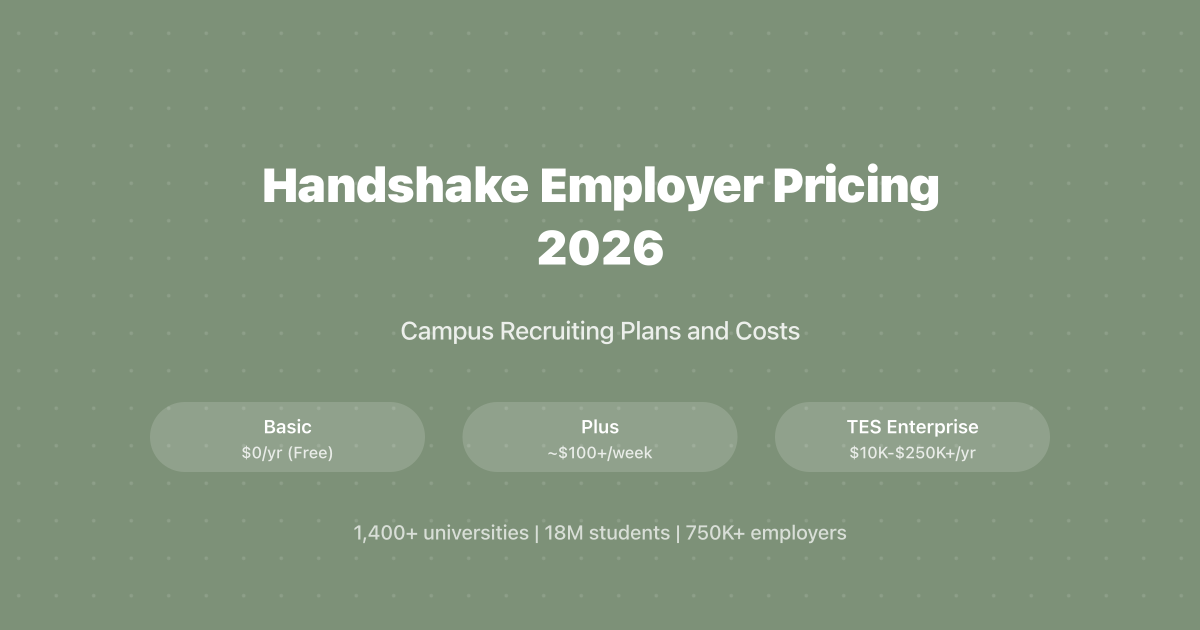
Handshake pricing in 2026 starts at $0 for its Basic employer plan and scales to $250,000+ per year for enterprise Talent Engagement Suite (TES) contracts, according to procurement data from Vendr (2025) and PricingNow (2026). The median TES contract sits around $29,835/year based on three documented transactions in Vendr's database. A mid-tier plan called Handshake Plus uses flexible per-job billing that employers report costs $100+ per week.
Handshake connects employers to 18 million students and alumni across 1,400+ universities, according to Sacra (2025). That reach makes it the dominant campus recruiting platform in the U.S. - but the gap between the free tier and the paid tiers is wider than most buyers expect. Features like ATS integrations, advanced filtering, and event management only unlock at the TES level, which requires an annual contract with custom pricing.
This guide breaks down exactly what Handshake costs at each plan level, maps the features you get (and don't get) at each tier, covers hidden costs and contract terms, compares Handshake to other campus recruiting platforms, and explains when a broader AI sourcing tool might be a better fit for your hiring goals.
TL;DR: Handshake's free Basic plan gives unlimited job posts across 1,400+ schools. The Talent Engagement Suite runs $10K-$250K+/yr, with a $29,835 median contract (Vendr, 2025). Plus costs $100+/week per job. TES add-on modules are priced separately. For teams that need both campus and experienced talent, AI sourcing tools like Pin start at $100/mo with 850M+ profiles.
Handshake operates a three-tier model. The Basic plan is free. The Plus plan uses per-job billing. The Talent Engagement Suite requires a custom annual contract. Here's what employers are actually paying at each level:

A few things to know about how Handshake structures its costs:
Here's what trips buyers up: the jump from free to paid on Handshake isn't gradual. Basic gives you unlimited job postings but caps your ability to proactively reach students. The moment you need targeted outreach campaigns, ATS integrations, or filtering beyond basic criteria, you're looking at an enterprise contract - not a $50/month upgrade, but a five-figure annual commitment. There's no mid-range option for teams that want more than free but less than enterprise.
The feature gap between Handshake's tiers is the sharpest part of its pricing model. According to Handshake's plan comparison page, critical recruiting features like ATS integrations, team licenses, and full-funnel analytics are locked behind the enterprise tier. Here's the complete breakdown:
| Feature | Basic (Free) | Plus | TES (Enterprise) |
|---|---|---|---|
| Unlimited job postings | Yes | Yes | Yes |
| Applicant review/management | Yes | Yes | Yes |
| Messaging templates | Yes | Yes | Yes |
| Personalized candidate messages | Limited | Limited | Unlimited |
| Talent matches | Limited | Limited | Unlimited |
| Talent filtering | Limited | Limited | 50+ filters |
| Large-scale campaigns | No | Limited | Yes |
| Campaign analytics | No | Limited | Yes |
| Engagement history tracking | No | No | Yes |
| School network management | No | No | Advanced |
| ATS integrations | No | No | Yes |
| Team member licenses | No | No | Up to 25 |
| Dedicated CSM | No | No | Yes |
| Full-funnel analytics | No | No | Yes |
| Event management | No | Limited | Unlimited |
| Professional brand pages | Basic | Basic | Comprehensive |
Source: Handshake Compare Plans (2025).
The pattern is consistent: Basic and Plus share most of the same limitations. The real unlock happens at the Talent Engagement Suite. Features like ATS integrations, engagement history, and team licenses - things most recruiting teams consider table stakes - only exist at the enterprise tier. If your team has more than one recruiter working on campus hiring, or if you need to connect Handshake to your existing applicant tracking system, the TES is your only option. Teams building a broader campus recruiting strategy should evaluate whether Handshake's TES pricing justifies the feature gate, or whether combining the free tier with a standalone sourcing tool delivers better ROI.
The Talent Engagement Suite includes 50+ talent filters, unlimited personalized messaging, school network management across 1,400+ campuses, up to 25 team seats, a dedicated CSM, and full-funnel analytics. Handshake's approximately 1,200 paying TES customers generate $300M in ARR as of late 2025, per Sacra - implying an average contract value around $250,000, though that's skewed heavily by Fortune 500 deals. Here's what TES includes beyond the features in the comparison table above.
The base Talent Engagement Suite subscription doesn't include everything. These modules are priced separately and require a conversation with Handshake's sales team:
Handshake's marketing claims enterprise customers see 2x application volume, 6.5x qualified applicants, and 6.8x talent responsiveness - but those are Handshake's own performance metrics and haven't been independently verified. Take them as directional, not absolute.
Handshake shipped two major product releases in 2025. Most meaningful updates - AI-assisted messaging, redesigned school management tools, and improved event conversion - landed exclusively behind the enterprise paywall. Basic plan users saw only minor changes. Here's what each release added and which tiers it applies to.
The fall 2025 release, documented on Handshake's employer blog, introduced several features for enterprise plan customers:
The summer 2025 release added three features that expand Handshake's reach:
These updates are worth factoring into your cost-benefit analysis. If you're evaluating the Talent Engagement Suite, the fall 2025 school management improvements and AI messaging tools add tangible value that wasn't in the product a year ago. But if you're on the Basic plan, most of the meaningful updates landed behind the TES paywall.
Because TES pricing is custom, there's room to negotiate. Vendr's procurement data suggests the negotiable range is significant - their documented transactions range from under $10,000 to well over $100,000 for similar-sized programs. Here are the factors that give you negotiating power:
One detail that's easy to miss: Handshake's ~1,200 paying TES customers generate $300M in ARR, according to Sacra (2025). That implies an average contract value around $250,000 - but that average is pulled up by Fortune 500 deals worth millions. If you're a mid-market company getting quoted $50K+, you're likely above the median and have room to negotiate down toward the $29,835 figure in Vendr's transaction data.
Handshake's hidden costs fall into three categories: Plus billing complexity (weekly cycles, email-only cancellation), TES renewal escalation tied to usage growth, and add-on module pricing that can double the base TES cost. Employers on G2 and TrustRadius consistently flag these costs as invisible during the sales process. Here's what to watch:
In February 2025, Handshake changed its Plus billing terms with less than seven days' notice, according to multiple G2 reviews. A single email sent on January 31, 2025, announced the change. Employers who missed that email were billed under the new terms the following week. Common complaints include:
The cancellation friction is worth taking seriously. Unlike most SaaS platforms where you can cancel with a button click, Handshake's email-only cancellation process adds delay. If you're testing Plus for a seasonal campus recruiting push, set a calendar reminder to cancel before your billing cycle renews. Don't assume the charges will stop when you stop using the platform.
Handshake isn't the only campus recruiting platform, but it has the largest university network. According to TrustRadius (2025), RippleMatch starts at $30,000/year with no free tier. Symplicity's Pro plan costs $329/month for up to 10 schools. Here's how the major platforms compare:
| Platform | Free Tier | Entry Paid Price | Enterprise Price | University Network |
|---|---|---|---|---|
| Handshake | Yes (unlimited posts) | Plus: ~$100+/week | TES: $10K-$250K+/yr | 1,400+ schools |
| Symplicity | No | $329/mo (up to 10 schools) | $20K-$100K+/yr | 500+ schools |
| RippleMatch | No | $30,000/yr min | Custom | Not disclosed |
| Yello | No | Custom only | Custom | Not disclosed |
| GR8 People | No | Custom only | Custom | Not disclosed |
Sources: Symplicity (2025), TrustRadius (2025), Vendr (2025).

Handshake's competitive advantage is straightforward: it's the only platform with a usable free tier and the largest school network. RippleMatch's $30,000 minimum shuts out smaller employers entirely. Symplicity's $329/month is more accessible but caps you at 10 schools unless you upgrade to a custom enterprise plan.
What the comparison table doesn't show is the scope difference. Every platform listed above focuses exclusively on campus talent - students and recent graduates. For teams building a broader early-talent pipeline, our guide to campus recruiting strategies covers sourcing tactics that work beyond any single platform. If your team hires across experience levels, you'll end up paying for a campus platform plus a separate sourcing tool for mid-career and senior hires. That combined cost often exceeds what a single AI recruiting platform would charge to cover all experience levels in one subscription.
Handshake is the right choice if campus recruiting is your primary hiring channel, you recruit from 20+ universities, or you run a large internship program. Employers who use Handshake at scale rate it 4.4/5 on G2 (2025), with enterprise users consistently citing the highest ROI for large internship programs. It falls short for teams that also hire experienced professionals, need automated outreach beyond basic messaging, or can't justify the jump from free to a five-figure enterprise contract.
If your team needs both campus and experienced talent, Pin's AI scans 850M+ profiles across all experience levels with automated outreach and scheduling - try it free.
For campus recruiting strategies that extend beyond Handshake's network, broader AI sourcing tools fill the gap. Pin searches 850M+ candidate profiles - including recent graduates - with automated outreach that hits a 48% response rate across email, LinkedIn, and SMS. The difference is scope: Handshake gives you campus talent on one platform, while Pin gives you campus, mid-career, and senior talent with sourcing, outreach, and scheduling in a single workflow.
"I jumped into Pin solo toward the end of 2025 and closed out the year with over $1M in billings during just the final 4 months - no team, no agency," says Nick Poloni, President at Cascadia Search Group. "The sourcing data is incredible, scanning 850M+ profiles with recruiter-level precision to uncover perfect-fit candidates I'd never find otherwise."
Where Handshake starts at $10K+/year for its TES and covers only campus talent, Pin's Professional plan costs $149/month with a free tier that requires no credit card. For teams that need to hire across experience levels, a tool like Pin covers the full pipeline at a fraction of what a campus-only platform plus a separate sourcing tool would cost. See how Pin fits into a broader recruiting tech stack alongside or instead of campus-specific tools.
Handshake earns a 7.8/10 on TrustRadius (71 reviews) and 4.4/5 on G2 (~50 reviews), but satisfaction splits sharply by plan tier - Basic users are positive, Plus users are mixed, and TES customers cite Handshake pricing opacity as their main complaint.
Employers on the Basic plan are overwhelmingly positive. The consensus is simple: unlimited free job postings across a network of 1,400+ schools is hard to argue with. Multiple TrustRadius reviewers cite cost savings compared to traditional campus recruiting methods like career fairs, travel, and third-party campus event sponsorships. For small companies running their first campus recruiting effort, the Basic plan delivers real value at zero cost.
Sentiment is mixed. Employers who get strong application volume from boosted postings see Plus as worth the weekly cost. But the billing transparency complaints are consistent: the exact per-job charge isn't visible until checkout, weekly billing feels unfamiliar, and the February 2025 pricing change caught multiple employers off guard. The cancellation process is a recurring pain point - email-only support with no phone line means disputes take days to resolve.
TES customers at larger companies tend to be satisfied with the platform's capabilities, especially the school network management tools and campaign analytics. The complaints center on pricing opacity and renewal negotiations. Because TES costs are custom, employers can't easily benchmark their contract against peers. Several G2 reviewers mention surprise price increases at renewal that weren't aligned with their usage growth. For Fortune 500 companies with dedicated campus recruiting budgets, the TES is an established line item. For mid-market companies evaluating it for the first time, the lack of published pricing makes budgeting harder than it needs to be.
Yes, Handshake's Basic plan is free with unlimited job postings across 1,400+ partner universities. No credit card is required. However, features like ATS integrations, advanced filtering with 50+ criteria, team member licenses, and campaign analytics require the paid Talent Engagement Suite, which starts around $10,000/year for small programs.
The TES ranges from roughly $10,000 to $250,000+ per year depending on program size, according to Vendr (2025) and PricingNow (2026). The median documented transaction sits at $29,835/year. All TES contracts require a minimum one-year commitment with annual billing. Add-on modules like Events and Insights carry separate costs.
Plus uses flexible per-job billing at roughly $100+ per week and provides limited campaign features. TES is an annual contract ($10K-$250K+/yr) that unlocks ATS integrations, 50+ talent filters, up to 25 team seats, a dedicated customer success manager, and full-funnel analytics. Plus is only available to off-campus employers, while TES is open to all employer types.
Handshake's free Basic plan is the most accessible entry point for campus recruiting. No competitor offers a comparable free tier - Symplicity starts at $329/month and RippleMatch at $30,000/year. For teams that need both campus and experienced talent, AI recruiting platforms like Pin start at $100/month and search 850M+ profiles across all experience levels, combining sourcing, outreach, and scheduling in one tool.
Plus uses 7-day billing cycles, and you can cancel before a new cycle starts. You're charged a pro-rated daily rate for days used. However, multiple G2 reviewers (2025) report that the cancellation process is email-only with no phone support, and charges may continue if you miss the cancellation window. TES contracts have a one-year minimum and can't be cancelled mid-term.