JazzHR Pricing 2026: Plans, Costs, and Feature Breakdown
JazzHR costs $75-$420/mo on annual billing across 3 plans. Exact add-on fees, the Hero plan
JazzHR costs $75-$420/mo on annual billing across 3 plans. Exact add-on fees, the Hero plan
Last updated: April 4, 2026
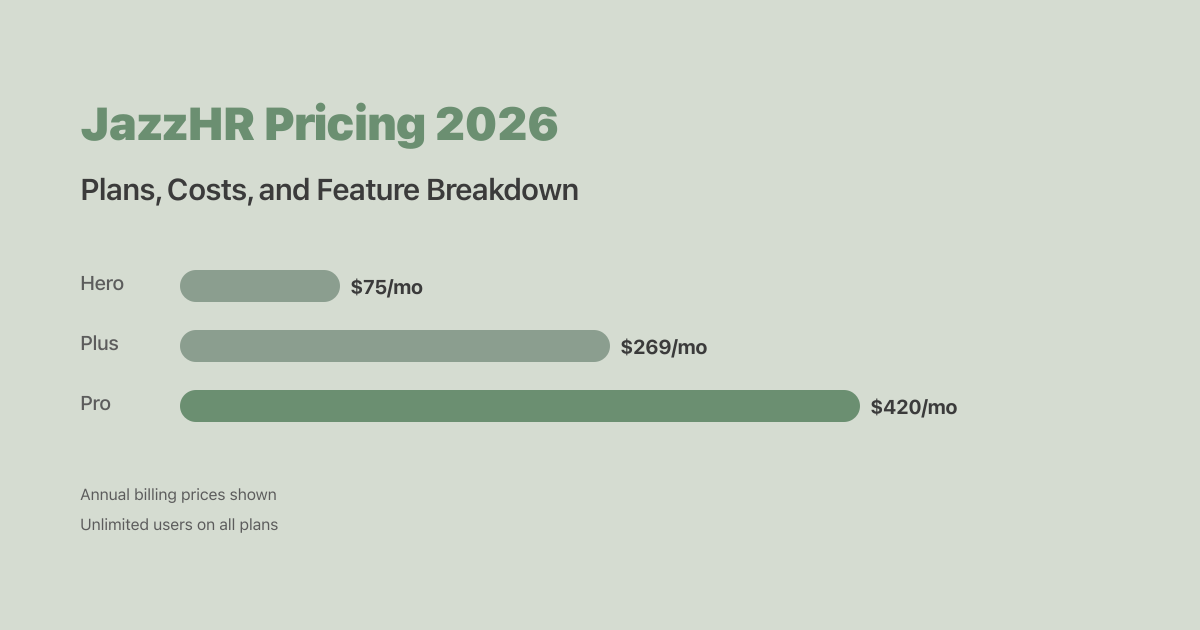
JazzHR costs $75/month on annual billing for the Hero plan, $269/month for Plus, and $420/month for Pro. Monthly billing runs higher: $99, $325, and $499, respectively. That makes JazzHR one of the most affordable applicant tracking systems for small businesses - but the Hero plan's hard cap at 3 open jobs means most growing teams will need to upgrade fast.
JazzHR is owned by Employ Inc., the same parent company behind Lever and Jobvite. The platform serves 10,000+ companies and has helped fill 200,000+ positions, according to JazzHR's website. It holds a 4.3/5 rating on both G2 (483 reviews) and Capterra (487 reviews) as of 2026.
This guide breaks down exactly what each JazzHR plan includes, maps the add-on costs that aren't obvious on their pricing page, and compares JazzHR to five alternatives. If you're evaluating JazzHR for a small or mid-size team, you'll know the real cost before you sign.
TL;DR: JazzHR costs $75/mo-$420/mo on annual billing across three tiers. The Hero plan caps at 3 jobs, making it viable only for micro-teams. Add-ons like candidate texting ($39/mo) and eSignature ($59/mo) push real costs higher. JazzHR tracks applicants but doesn't source candidates - teams that need outbound sourcing will need a separate tool alongside their ATS.
According to JazzHR's pricing page (2026), all three plans are publicly listed with transparent pricing - no sales call required. That's unusual in the ATS market, where most platforms above the entry level hide behind "contact us" buttons. Here's what each tier costs:

A few things to know about how JazzHR charges:
JazzHR's flat-fee model sounds simple, but the 3-job cap on Hero changes the math quickly. A company with 4 open positions can't stay on the $75/mo plan. They either jump to Plus at $269/mo - a 258% increase - or pay $9/job/month for additional postings. A Hero plan with 10 open jobs costs $75 + (7 x $9) = $138/mo, which still undercuts Plus. But at 25 jobs, you hit $273/mo and Plus becomes the better deal. Model your actual job volume before picking a plan.
JazzHR's three plans differ primarily on job limits: Hero caps at 3 active jobs ($75/mo), Plus allows up to 200 ($269/mo), and Pro is unlimited ($420/mo) - all with unlimited users on every tier. That unlimited-user model removes the per-seat cost anxiety that plagues buyers of Greenhouse, Lever, and most enterprise ATS platforms. Here's what each tier delivers based on JazzHR's pricing page:
| Feature | Hero ($75/mo) | Plus ($269/mo) | Pro ($420/mo) |
|---|---|---|---|
| Active Jobs | 3 (hard cap) | Up to 200 | Unlimited |
| Users | Unlimited | Unlimited | Unlimited |
| Job Posting Syndication | ✅ | ✅ | ✅ |
| Candidate Management | ✅ | ✅ | ✅ |
| Custom Workflows | ✅ Basic | ✅ Advanced | ✅ Advanced |
| Interview Scheduling | ✅ Basic | ✅ | ✅ |
| Offers & eSignature | Paid add-on ($59/mo) | Paid add-on ($59/mo) | ✅ Included |
| Advanced Visual Reporting | Paid add-on ($59/mo) | Paid add-on ($59/mo) | ✅ Included |
| Candidate Texting | Paid add-on ($39/mo) | Paid add-on ($39/mo) | Paid add-on ($39/mo) |
| Zoom Integration | Paid add-on ($29/mo) | Paid add-on ($29/mo) | Paid add-on ($29/mo) |
| Compliance (EEOC/OFCCP) | ✅ | ✅ | ✅ |
| AI Screening Tools | ❌ | ✅ | ✅ |
| All-Access Support | Paid add-on ($49/mo) | Paid add-on ($49/mo) | Paid add-on ($49/mo) |
The Hero plan works for very small teams with 1-3 open roles at a time - think a 10-person startup with occasional hiring needs. At $75/mo, it's one of the cheapest ATS options on the market. But the 3-job cap means you'll outgrow it the moment hiring picks up.
Plus makes sense for companies with steady hiring across 4-200 open positions. At $269/mo, the jump from Hero is steep, but you get AI screening tools and advanced workflows that Hero lacks. Most JazzHR customers land on this tier.
Pro is built for high-volume hiring teams that need unlimited jobs, built-in eSignature, and advanced reporting without paying for add-ons. At $420/mo ($5,040/yr), it's still cheaper than most mid-market ATS platforms. If you'd need both the eSignature ($59/mo) and reporting ($59/mo) add-ons on Plus anyway, Pro saves $167/mo over Plus with add-ons.
JazzHR's published pricing is straightforward compared to most ATS platforms, but several costs aren't immediately obvious from the pricing page. Here's what can inflate your bill beyond the base subscription.
The Hero plan's 3-job cap includes a paid workaround: $9/job/month for each additional posting. That sounds minor until you do the math. Posting 10 active jobs on Hero costs $75 + $63 = $138/mo. Posting 25 jobs costs $273/mo - at which point you should've picked Plus ($269/mo) from the start. JazzHR doesn't prominently surface this crossover point.
SMS outreach isn't included in any plan. The Candidate Texting add-on costs $39/month regardless of your tier. Given that text message response rates typically outperform email in recruiting, many teams consider this essential rather than optional. That's $468/yr in extra spend not reflected in the base price.
Hero and Plus customers who want to send offer letters and collect electronic signatures within JazzHR pay $59/mo extra. Only the Pro plan includes this feature. If you're sending offers through a separate tool today, this might not matter. But if you want a unified workflow from application to signed offer, factor in the add-on cost.
Standard JazzHR support is limited to email and help center articles. If you want phone support, live chat, and priority ticket handling, that's $49/mo extra across all plans - even Pro. For a team implementing JazzHR for the first time, that first-year support investment might be worth it, but the ongoing cost adds up.
JazzHR doesn't offer self-service cancellation. You need to contact their support team directly to end your subscription. That's not a financial cost, but it's worth knowing before you commit. If you're testing JazzHR alongside other tools, be aware that walking away requires a conversation, not a button click.
When you layer add-ons onto a Hero plan, the true cost can surprise you. A team paying $75/mo for Hero that adds texting ($39/mo), 5 extra jobs ($45/mo), and all-access support ($49/mo) pays $208/mo - almost matching Plus at $269/mo, but with fewer features. Before committing to Hero with add-ons, price out what Plus would cost you with the same configuration. The sticker price doesn't tell the full story.
If add-on costs are stacking up and you're primarily looking for help finding candidates, it's worth considering whether an ATS is really your bottleneck. Pin's AI sourcing handles candidate discovery, outreach, and scheduling starting at $100/mo - a different tool for a different problem.
JazzHR holds a 4.3/5 rating on G2 (2026), so it works well for many teams. But recurring user complaints point to specific gaps that matter depending on your workflow and company size.
JazzHR is an applicant tracking system, not a sourcing platform. It tracks people who apply to your jobs. It doesn't help you find candidates who haven't applied yet. There's no candidate database, no AI-driven talent search, and no proactive outreach automation. If your pipeline depends on outbound sourcing rather than inbound applications, JazzHR won't fill that gap.
JazzHR doesn't offer a dedicated mobile app. The web interface works on mobile browsers, but reviewers on G2 and Capterra consistently flag the mobile experience as clunky. For recruiters who manage candidates on the go - screening resumes between meetings, reviewing applications during commutes - the lack of a native app is a daily friction point.
The Hero plan's 3-job limit is a hard cap, not a soft suggestion. You can't post a fourth job without paying $9/mo per extra listing or upgrading to Plus. For comparison, most competing ATS platforms offer higher job limits at their entry tier. This makes Hero viable only for micro-teams with minimal hiring volume.
Advanced Visual Reporting is a $59/mo add-on for Hero and Plus customers. Without it, you get basic pipeline views but limited ability to track time-to-fill, source effectiveness, or hiring funnel conversion rates by stage. If data-driven recruiting is your goal, you'll either pay for the add-on or upgrade to Pro.
JazzHR is one of three recruiting products under Employ Inc. (alongside Lever and Jobvite). While Employ has invested in AI features across its portfolio - launching an AI Screening Companion in late 2025, according to GlobeNewswire - multi-brand conglomerates sometimes spread R&D investment across products rather than concentrating it on one. Buyers should evaluate JazzHR's recent feature velocity against competitors that focus exclusively on a single product.
JazzHR's Hero plan at $900/yr is the cheapest dedicated ATS on this list - roughly half of Workable's entry price and a fraction of Greenhouse's $6,000+/yr minimum. But as your hiring needs grow, the price gap narrows. Here's how JazzHR stacks up against five alternatives that small and mid-size teams commonly evaluate:

| Platform | Starting Price | Free Tier | Pricing Model | AI Sourcing |
|---|---|---|---|---|
| JazzHR Hero | $75/mo ($900/yr) | ❌ (21-day trial) | Flat fee, job caps | ❌ |
| Workable | $169/mo (~$2,028/yr) | ❌ | Per-seat + employee count | ⚠️ Basic |
| BambooHR | ~$10-25/employee/mo | ❌ | Per employee | ❌ |
| Greenhouse | ~$6,000/yr | ❌ | Per-seat, tiered | ⚠️ Paid add-on |
| iCIMS | ~$20,400/yr | ❌ | Quote-based | ⚠️ Basic |
| Pin | $100/mo ($1,200/yr) | ✅ No credit card | Flat fee, tiered | ✅ 850M+ profiles |
A few patterns worth noting in this comparison. JazzHR is the cheapest dedicated ATS at entry level - by a wide margin. Its unlimited-users model also means you won't face per-seat surprises as your team grows. But none of the ATS platforms on this list (JazzHR included) offer AI-powered candidate sourcing as a core capability. They're built to track applicants, not find them.
For a deeper look at how these platforms compare on features beyond pricing, see our guide to the best applicant tracking systems in 2026.
Workable starts at $169/mo, Greenhouse at roughly $6,000/yr, and iCIMS at $20,400+/yr - a wide range that reflects different target markets. Here's how each alternative compares to JazzHR on features, pricing model, and where they fall short.
Workable starts at $169/mo and includes AI-powered job description generation and basic candidate sourcing at every tier. It's more expensive than JazzHR but packs more features into its base plans. The trade-off is per-seat pricing that scales with your team size, which can make it expensive for companies with many hiring managers. Good for teams that want an all-in-one platform without add-on sprawl.
BambooHR charges per employee ($10-25/employee/mo) and is primarily an HRIS, not a dedicated ATS. Its recruiting module is limited - no outreach automation, basic pipeline management, and minimal customization. If you already run BambooHR for HR and payroll, its recruiting add-on might save you a separate subscription. Otherwise, it's too light for teams with serious hiring needs. For a full cost breakdown, see our BambooHR pricing guide.
Greenhouse targets mid-market and enterprise teams with structured hiring workflows, 400+ integrations, and strong compliance features. Starting at roughly $6,000/yr, it's 6-7x more expensive than JazzHR's entry point. For a full cost breakdown, see our Greenhouse pricing guide. Good for companies with 100+ employees that need deep workflow customization and a large integration ecosystem.
iCIMS is built for enterprises processing thousands of applications monthly. Starting around $20,400/yr, it's the most expensive platform on this list. iCIMS handles high-volume hiring well but requires significant implementation investment and a dedicated admin. Most small and mid-size teams find it overbuilt and overpriced for their needs.
What's missing from every ATS on this list? The ability to find candidates who haven't applied yet. These tools are excellent at managing your inbound pipeline. They're not designed to run outbound sourcing campaigns, search candidate databases, or automate multi-channel outreach. If finding candidates is your bottleneck, an ATS alone - regardless of price - won't solve it.
According to Mordor Intelligence (January 2026), the global ATS market reached $2.65 billion in 2026 and is projected to grow to $3.76 billion by 2031 at a 7.25% CAGR. SMEs are the fastest-growing segment at 8.21% CAGR. JazzHR is squarely positioned for that growth - 45% of its customer base has fewer than 50 employees, and 48% are mid-size, according to Enlyft (2026).
JazzHR makes sense when your team needs an affordable, no-frills ATS with transparent pricing and unlimited users. Its flat-fee model is genuinely friendlier to small businesses than the per-seat pricing used by Greenhouse, Lever, and Workable. And the 21-day free trial lets you test before committing budget.
Where JazzHR struggles is when your needs outgrow its design. Here's a framework:
An ATS tracks applicants after they find you. But according to Employ Inc.'s 2026 Hiring Benchmarks Report (data from 6,640 customers including JazzHR users), the average time-to-fill was still 63.5 days in 2025. That number improved from 67.7 days in 2024, but a two-month time-to-fill isn't fast enough for most growing teams.
The reason? An ATS manages who's already in your pipeline. It doesn't help you build that pipeline in the first place. If your roles stay open because you can't find enough qualified candidates - not because you can't track the ones who apply - you need a sourcing tool, not a better ATS.
Pin starts at $100/mo and searches 850M+ candidate profiles across North America and Europe. It automates outreach across email, LinkedIn, and SMS, with a 48% response rate that outperforms industry averages. Recruiters using Pin fill positions in approximately two weeks - not two months.
As Nick Poloni, President at Cascadia Search Group, put it: "I jumped into Pin solo toward the end of 2025 and closed out the year with over $1M in billings during just the final 4 months - no team, no agency. The sourcing data is incredible, scanning 850M+ profiles with recruiter-level precision to uncover perfect-fit candidates I'd never find otherwise."
Here's how the investment compares:
| Capability | JazzHR (Plus) | Pin |
|---|---|---|
| Annual Cost | $3,228/yr ($269/mo) | $1,200/yr ($100/mo Starter) |
| Candidate Database | ❌ None (inbound only) | ✅ 850M+ profiles |
| AI-Powered Search | ⚠️ AI screening only | ✅ Advanced AI matching |
| Multi-Channel Outreach | ❌ | ✅ Email, LinkedIn, SMS |
| Outreach Response Rate | Not applicable | 48% |
| Interview Scheduling | ✅ Basic | ✅ Automated |
| Free Tier | ❌ (21-day trial) | ✅ No credit card required |
| SOC 2 Certified | Not disclosed | ✅ |
JazzHR and Pin solve different problems, so comparing them directly isn't quite fair. But that's exactly the point. Many teams buy an ATS thinking it will fix their hiring speed. The ATS handles compliance and workflow - it doesn't generate candidates. A team running JazzHR Plus ($269/mo) and Pin Starter ($100/mo) together spends $369/mo total - less than JazzHR Pro alone - and gets both applicant tracking and AI-powered sourcing. That combination covers the full hiring funnel at a fraction of what enterprise platforms charge.
Find candidates faster with Pin's AI sourcing - free to start
JazzHR's 24% annual billing discount saves up to $948/yr on the Pro plan alone - the single biggest cost lever most buyers miss. Beyond billing frequency, a few strategies can help you avoid overpaying and get more from the platform.
JazzHR costs $75/mo (Hero), $269/mo (Plus), or $420/mo (Pro) on annual billing. Monthly billing runs higher at $99, $325, and $499, respectively. All plans include unlimited users. The main difference between tiers is the number of active jobs allowed: 3 on Hero, 200 on Plus, and unlimited on Pro.
JazzHR offers a 21-day free trial but no permanent free plan. After the trial, you'll need a paid subscription starting at $75/mo (annual billing). If you want to test recruiting tools with no time limit and no credit card, AI sourcing platforms like Pin offer free tiers that let you evaluate candidate quality before committing budget.
Very few dedicated ATS platforms are cheaper than JazzHR's Hero plan at $75/mo. Most competitors start at $150-$400/mo. However, JazzHR's 3-job cap on Hero means the effective cost rises quickly once you need more than 3 active postings. For sourcing specifically, Pin offers a free tier and starts at $100/mo with 850M+ candidate profiles - a different tool but a comparable price point.
JazzHR is designed specifically for small businesses. According to Enlyft (2026), 45% of JazzHR's customers have fewer than 50 employees. Its flat-fee pricing with unlimited users makes it affordable for small teams. The main limitation is that it tracks applicants but doesn't help you source candidates proactively.
JazzHR excels at applicant tracking but doesn't include candidate sourcing. For teams whose pipeline depends on finding passive candidates, Pin searches 850M+ profiles with AI-powered matching and automates outreach across email, LinkedIn, and SMS with a 48% response rate. Many small teams pair JazzHR's ATS ($75/mo) with Pin's sourcing ($100/mo) for full-funnel coverage at $175/mo total.
JazzHR's Pro plan costs $5,040/yr - still cheaper than most mid-market ATS platforms that start at $6,000-$40,000+/yr. The flat-fee model with unlimited users genuinely differentiates it from per-seat competitors. For small teams that need basic applicant tracking, compliance, and job posting syndication, it's hard to beat at $75/mo.
But the 3-job cap on Hero, add-on fees for features like texting and eSignature, and the absence of any candidate sourcing capability mean JazzHR has clear boundaries. When your hiring needs grow beyond basic tracking, you'll either upgrade within JazzHR or supplement it with specialized tools.
For teams where the real challenge is finding qualified candidates - not just managing the ones who apply - a dedicated AI sourcing tool delivers higher ROI per dollar spent than any ATS upgrade. Consider whether your budget is better spent on a better tracker or a better finder.
Start sourcing candidates with Pin - free, no credit card required →