How to Reject Candidates Professionally: Email Templates (2026)
53% of candidates are ghosted by employers. 6 rejection email templates, phone scripts, and timing benchmarks to protect your employer brand at every stage.
53% of candidates are ghosted by employers. 6 rejection email templates, phone scripts, and timing benchmarks to protect your employer brand at every stage.

Reject candidates professionally by responding within one week, personalizing the message to the stage they reached, and offering specific feedback after interviews. That single practice - closing the loop with every candidate - separates companies that build lasting talent pipelines from those bleeding employer brand equity through silence.
The data is stark. 53% of job seekers were ghosted by an employer in the past year, a three-year high up from 48% in 2025 and 38% in 2024, according to Criteria Corp research reported by Fortune (March 2026). And 59.7% of job seekers say ghosting is their top frustration with the hiring process, per iHire's 2025 State of Online Recruiting survey (n=1,024).
Meanwhile, candidate resentment hit an all-time high in 2024 - the worst in 13 years of tracking - with a 40% increase since 2016, according to the Talent Board CandE Benchmark Research published by ERE. This guide gives you the templates, timing benchmarks, and strategies to reject candidates with professionalism at every stage.
TL;DR: Reject every candidate within one week. Match the method to their stage: automated email for applications, personal email after phone screens, phone calls after interviews. Honest feedback drops resentment 29% and lifts referral willingness 50% (Talent Board CandE, 2024). Six templates below.
Candidate resentment drops 29% when employers provide honest feedback on qualifications and job fit, according to the Talent Board CandE research reported by Radancy (2024). That's not a marginal improvement. It's the difference between a candidate who warns friends away from your company and one who reapplies next quarter.
More importantly, the ripple effects go deeper than brand protection. Candidates who receive specific feedback after interviews show 50% higher NPS for referral willingness, per the same Talent Board CandE data. They don't just tolerate the rejection - they actively send other qualified people your way. That's free sourcing from candidates you didn't even hire. In other words, a professional rejection doesn't close a door. It opens a referral channel.

Beyond brand damage, silence is expensive in both directions. SHRM's 2025 Talent Trends report found that 41% of organizations now see candidates ghosting them during interviews. Poor rejection handling creates a cycle: employers ghost candidates, candidates learn to ghost employers, and everyone's pipeline suffers. The irony is hard to miss - the same companies complaining about candidate no-shows are often the ones who never responded to applicants in the first place.
The employer brand damage compounds on review sites. Rejected candidates who had a negative experience share it widely - and 83% of job seekers check company reviews before applying, according to Glassdoor's employer branding research. A pattern of ghosted candidates turns into a pattern of negative reviews, which shrinks your future applicant pool for months. On the other hand, 71% of job seekers say their perception of a company improves when the company responds to reviews, per the same Glassdoor data. The fix isn't complicated. It's communication - and it works in both directions.
34% of candidates assume they've been ghosted after just one week of silence, according to the Criteria Corp 2024 Candidate Experience Report (n=2,516). The majority assume ghosting after two weeks. That means your window for a professional rejection is smaller than most recruiters think.
SHRM's May 2025 guidance recommends matching the rejection method to the stage a candidate reached. Here's what that looks like in practice:
| Stage | Ideal Timing | Method | Personalization Level |
|---|---|---|---|
| Application received | Within 1 week | Automated email | Role name + candidate name |
| Resume screen | Within 1 week | Automated or batch email | Role name + brief reason |
| Phone screen | Within 3-5 days | Personal email from recruiter | Specific feedback on fit |
| First interview | Within 3-5 days | Personal email with feedback | Skills/experience gaps noted |
| Final round | Within 24-48 hours | Phone call + follow-up email | Detailed feedback, future openings |
CandE award-winning companies - the top performers in candidate experience - disposition candidates at 3-5 days more consistently than average employers, per the Talent Board 2024 CandE research. And 29% of North American candidates reported waiting 1-2 months or more to hear back. Don't be one of those companies.
What about the impact of the method itself? Rejection via phone call increases positive candidate ratings by 32% compared to automated email, according to the same Talent Board data. Yet only 10% of rejections happen by phone. The breakdown: 58% automated email, 22% personal email, 10% phone call. Phone calls take more time, but they pay off disproportionately - especially for candidates who invested multiple rounds of interviews.

61% of job seekers have been ghosted after an interview, per Greenhouse's 2024 State of Job Hunting Report (n=2,500). These templates close that gap. Each one is tailored to the candidate's stage and investment level - because a person who submitted a resume deserves a different message than someone who flew in for a final round.
A few principles apply to every template below. Use the candidate's first name. Reference the specific role. Send from a real person's email address, not a no-reply inbox. And never include false encouragement like "we'll keep your resume on file" unless you actually have a talent pool system to back that up.
Use when a candidate applied but wasn't selected for a phone screen. Send within one week of the application.
Subject: Your application for [Role Title] at [Company]
Hi [First Name],
Thank you for applying for the [Role Title] position at [Company]. After reviewing applications, we've decided to move forward with other candidates whose experience more closely matches this role's requirements.
We appreciate your interest and the time you invested. We'd encourage you to check our careers page for future openings that may be a stronger fit.
Best regards,
[Recruiter Name]
[Company]
Use when a candidate was reviewed in detail but doesn't meet key qualifications. Include one specific reason.
Subject: Update on your [Role Title] application
Hi [First Name],
Thank you for your interest in the [Role Title] role at [Company]. After a thorough review of your background, we've decided to move forward with candidates who have more direct experience in [specific skill or qualification].
Your background in [something positive you noticed] stood out, and we'd welcome you to apply for future roles that align more closely with your expertise.
Best,
[Recruiter Name]
Use after a phone or video screening call. Reference something specific from the conversation.
Subject: Following up on our conversation - [Role Title]
Hi [First Name],
Thank you for taking the time to speak with me about the [Role Title] position. I enjoyed learning about your experience with [specific topic discussed].
After careful consideration, we've decided to move forward with candidates whose background is a closer match for [specific requirement - e.g., "the enterprise sales focus of this role" or "the Python-heavy technical stack"].
I was genuinely impressed by [specific strength]. If a role comes up that's a better fit for your profile, I'd like to reach out. Would that be okay?
Thanks again for your time,
[Recruiter Name]
Use after a first-round interview. Include feedback and leave the door open. For more frameworks on structuring post-interview communication, see our guide to interview feedback examples and templates.
Subject: Your interview for [Role Title] at [Company]
Hi [First Name],
Thank you for interviewing for the [Role Title] position. Your [specific positive - e.g., "presentation on campaign strategy" or "system design approach"] gave the team a lot to discuss.
After comparing all candidates, we've decided to move forward with someone whose experience in [specific area] was a closer fit for this particular role. This was a difficult decision - you were among our top candidates.
I'd welcome the chance to connect again for future roles. Would you be open to staying in touch?
Warm regards,
[Recruiter Name]
[Direct phone number]
Use after a candidate completed multiple interviews or a final panel. Pair this email with a phone call (see the phone rejection section below).
Subject: [Role Title] decision - thank you, [First Name]
Hi [First Name],
As we discussed on our call, we've made the difficult decision to extend the [Role Title] offer to another candidate. I want to reiterate how much the team valued meeting you.
Your [specific strength - e.g., "deep knowledge of compliance frameworks" or "ability to translate technical concepts for non-technical stakeholders"] made a strong impression. The deciding factor was [honest, specific reason - e.g., "the other candidate's direct experience managing a team of this size"].
I'd genuinely like to keep you in mind for future opportunities. I'll reach out directly if something opens up that matches your profile. In the meantime, please don't hesitate to connect with me on LinkedIn.
With respect,
[Recruiter Name]
[Direct phone number]
[LinkedIn URL]
Use for current employees who applied for an internal transfer or promotion. Handle these with extra care - this person still works with you tomorrow.
Subject: [Role Title] - next steps
Hi [First Name],
Thank you for your interest in the [Role Title] position and for going through the interview process. We've decided to go in a different direction for this particular role.
I'd like to schedule a 30-minute meeting to discuss the feedback from the interview panel and talk about what would strengthen your candidacy for similar roles in the future. The team noted your [specific positive], and there are clear paths to build on that.
Would [specific day/time] work for a conversation?
Best,
[Hiring Manager Name]
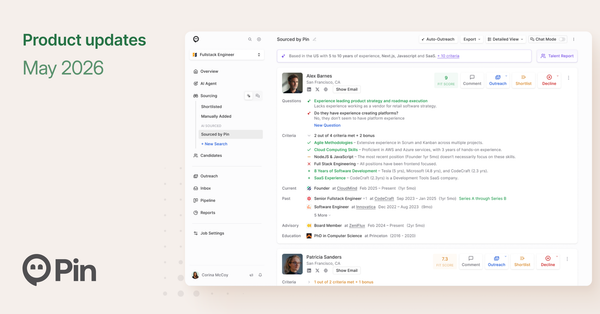
Pin's multi-channel outreach hits a 48% response rate and handles candidate communication across email, LinkedIn, and SMS from a single inbox - try Pin's automated outreach free.
Phone rejections increase positive candidate ratings by 32% compared to automated email, per Talent Board CandE research reported by Radancy (2024). Yet only 10% of rejections happen this way. If a candidate completed an in-person or final-round interview, a phone call isn't optional - it's the minimum professional standard.
Here's a framework that works:
Before the call:
During the call:
After the call:
What you don't say matters too. Never blame the decision on "the team" without specifics. Never say "you were our second choice" even if true - it doesn't help. And never ghost after promising a call. If you said you'd follow up by Friday, follow up by Friday. A bad rejection on time beats a perfect rejection two weeks late.
Most rejection processes end at "no." That's a missed opportunity. A well-handled rejection doesn't just protect your brand - it builds a pipeline of pre-vetted candidates who already know your company, your culture, and your hiring process. And those candidates are dramatically cheaper and faster to hire the second time around because you've already evaluated their skills and fit.
Research consistently shows that candidates are significantly more likely to reapply to a company that notified them of their status versus one that ghosted them. The Talent Board data reinforces this: candidates who receive specific feedback show 50% higher NPS for referral willingness. They don't just come back themselves - they send friends.
Here's how to build a rejection-to-reapply pipeline:
1. Tag and categorize rejected candidates. Not every rejection is permanent. Create categories in your ATS or CRM: "strong but wrong timing," "needs more experience," "culture fit but wrong role," and "not a match." The first three categories are your re-engagement pool.
2. Set re-engagement triggers. When a new role opens that matches a tagged candidate's profile, your system should surface them automatically. This is where AI-powered tools pay for themselves - Pin's AI scans 850M+ profiles and remembers previous searches and passes, so you spend less time re-reviewing candidates you've already evaluated.
3. Send a quarterly talent community update. A short, genuine email to your "silver medalist" pool - sharing company news, new openings, or industry insights - keeps the relationship warm without feeling pushy. Keep it under 150 words and include a one-click unsubscribe.
4. Close the loop on referrals. If a rejected candidate referred someone to you, follow up with the referrer about the outcome. That acknowledgment turns rejected candidates into active recruiters for your company.
As Rich Rosen, Executive Recruiter at Cornerstone Search and a Pin advisor, puts it: "Absolutely Money maker for Recruiters... in 6 months I can directly attribute over $250k in revenue to Pin." When you combine professional rejection handling with a tool that remembers every candidate interaction, no strong candidate falls through the cracks.
Some rejection mistakes are worse than not responding at all. According to Talent Board CandE research reported by Radancy (2024), resentment spikes hardest when candidates feel their time was wasted or the process was dishonest. Here's what to avoid:
Don't use these phrases:
Don't do these things:
There's a difference between feedback and oversharing. "We needed someone with five years of cloud architecture experience" is helpful. "The team felt you wouldn't fit the culture" is vague and potentially actionable. Keep it specific, job-related, and forward-looking.
One more thing worth noting: the tone of your rejection matters as much as the content. A formal, corporate-sounding rejection ("We regret to inform you...") feels impersonal even when the information is accurate. A warm, direct message from a real person ("I wanted to let you know personally...") communicates respect even when the news is disappointing. For a deeper look at how rejection handling fits into the full candidate experience, see our data-backed guide on improving every touchpoint.
The math problem behind ghosting is straightforward. According to SHRM's 2025 research, recruiters regularly manage high requisition loads, each generating dozens or hundreds of applicants. Manually personalizing rejections at every stage isn't realistic without automation. As a result, most teams default to silence - not out of malice, but because the volume overwhelms their capacity. That's where AI recruiting tools change the equation.
Here's what AI-powered rejection workflows look like in practice:
The key is that automation handles the volume while keeping communication personal. A tool that sends stage-appropriate rejections within 48 hours of a decision eliminates ghosting without adding recruiter workload. That's the goal: every candidate hears back, every time, without recruiters spending hours on template management. And when candidates do respond positively to a rejection - asking to stay in touch, expressing interest in future roles - that reply lands in a shared inbox where the entire team can see it and act on it.
When you're evaluating AI tools, look for multi-channel communication (email, LinkedIn, SMS), automated sequencing based on pipeline stage, and a shared team inbox so no candidate falls between the cracks. For more on how automation fits across the full recruitment funnel, see our breakdown of every stage from prospect to hire.
| Do | Don't |
|---|---|
| Respond within 1 week (3-5 days for interviews) | Ghost - ever, at any stage |
| Match rejection method to candidate's investment | Send the same template to every candidate |
| Reference something specific from their application or interview | Use vague phrases like "more qualified candidate" |
| Offer honest, job-related feedback after interviews | Reference protected characteristics or "culture fit" |
| Leave the door open for future roles (if genuine) | Promise to "keep their resume on file" if you won't |
| Send from a real person's email address | Use a no-reply inbox |
| Call final-round candidates before emailing | Reject on Friday afternoons or holidays |
| Tag rejected candidates for future re-engagement | Delete rejected candidates from your system |
Reject within 3-5 business days after an interview. The Criteria Corp 2024 report (n=2,516) found that 34% of candidates assume they've been ghosted after just one week of silence. CandE award-winning companies consistently close the loop within 3-5 days. For final-round candidates, aim for 24-48 hours with a phone call first.
Yes - especially after interviews. Providing honest feedback on qualifications and job fit reduces candidate resentment by 29%, according to Talent Board CandE research (2024). Keep feedback specific, job-related, and forward-looking. Avoid referencing protected characteristics or vague "culture fit" language. Specific feedback also increases referral willingness by 50%.
It depends on the stage. SHRM's May 2025 guidance recommends automated email for application-stage rejections, personalized email after phone screens, and phone calls for anyone who completed an in-person interview. Phone rejections increase positive candidate ratings by 32% compared to automated email, per Talent Board data.
Schedule a private conversation before sending anything in writing. Share specific, actionable feedback on what would strengthen their candidacy for similar roles. Offer a development plan or mentorship opportunity. Internal candidates will see the person who got the job every day - they need to hear the "why" directly from the hiring manager, not from an impersonal email.
Absolutely. Candidates who receive a rejection notification are significantly more likely to reapply than those who were ghosted, and candidates given specific post-interview feedback show 50% higher NPS for referral willingness (Talent Board CandE, 2024). A professional rejection turns today's "no" into tomorrow's applicant or referral source.
Automate your candidate communication with Pin's AI recruiting assistant →