DEI Metrics for Recruiting: What to Track and How (2026)
12 DEI recruiting metrics every hiring team should track, from pipeline diversity ratios to the four-fifths rule. 2026 benchmarks included.
12 DEI recruiting metrics every hiring team should track, from pipeline diversity ratios to the four-fifths rule. 2026 benchmarks included.
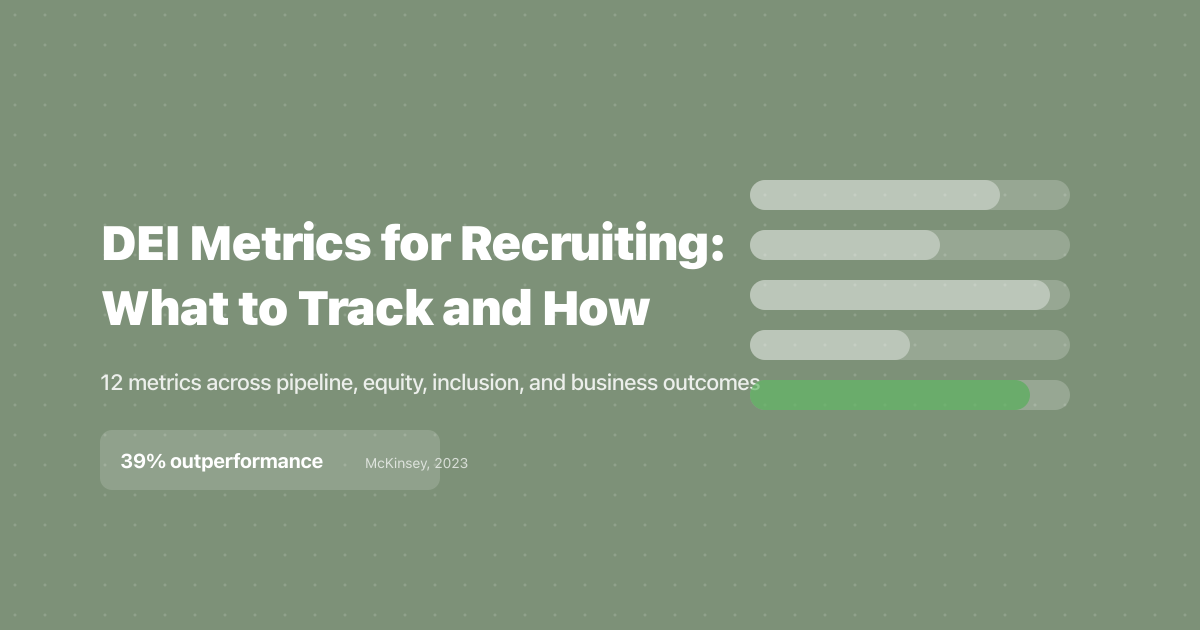
The DEI recruiting metrics that matter most fall into four categories: pipeline representation, equity and fairness, inclusion experience, and business outcomes. Track all four to move beyond surface-level reporting toward hiring decisions that actually hold up under scrutiny.
That distinction matters more than ever. According to SHRM's 2025 State of the Workplace report, 55% of CHROs anticipate companies will scale back or eliminate DEI initiatives entirely. At the same time, McKinsey's "Diversity Matters Even More" report found that companies in the top quartile for gender and ethnic diversity on executive teams are 39% more likely to financially outperform their bottom-quartile peers. The business case hasn't weakened - many organizations have simply lost track of which metrics to measure and how to act on them.
This guide breaks down the 12 metrics that separate performative reporting from real progress, shows you how to calculate each one, and explains what's changed in the legal landscape heading into 2026.
TL;DR: Track 12 DEI recruiting metrics across four categories: pipeline diversity, equity/fairness, inclusion experience, and business outcomes. McKinsey's 2023 research shows diverse executive teams are 39% more likely to outperform financially, yet SHRM reports 55% of CHROs expect DEI rollbacks. Measure what matters, tie every metric to a hiring decision, and audit your AI tools for adverse impact.
| Category | Metric | What It Measures | Key Threshold |
|---|---|---|---|
| Pipeline | 1. Applicant Pool Diversity Ratio | % underrepresented applicants vs. labor market | Within 10 pts of market |
| 2. Diverse Candidate Pass-Through Rate | Conversion rate by demographic at each funnel stage | No 20+ pt stage disparity | |
| 3. Diverse Slate Compliance Rate | % of requisitions with 2+ diverse finalists | 100% target | |
| Equity | 4. Adverse Impact Ratio | Selection rate disparity between groups | 0.80 (four-fifths rule) |
| 5. Interview-to-Offer Ratio by Demographic | Offer rates after interviews, segmented by group | No 15+ pt gap | |
| 6. Pay Equity at Point of Offer | Starting salary disparity by demographic | Controlled gap near $0 | |
| Inclusion | 7. Interview Panel Diversity | % of panels with underrepresented interviewer | 100% target |
| 8. Candidate Experience by Demographic | Satisfaction scores segmented by group | No 0.8+ pt gap | |
| 9. Offer Acceptance Rate by Demographic | Acceptance rates by group | No 10+ pt disparity | |
| Outcomes | 10. Retention by Demographic Cohort | 90-day, 6-mo, 1-yr retention by group | No 15+ pt gap |
| 11. Promotion Rate Disparity | Promotion rates within equivalent tenure/performance | Ratio above 0.80 | |
| 12. Revenue/Performance Correlation | Team performance segmented by diversity composition | Internal trend line |
Corporate DEI visibility is declining fast. The Conference Board's 2025 analysis found that DEI mentions in S&P 500 annual filings dropped from an average of 12.5 per filing in 2022 to just 4 in 2024 - a 68% reduction. The share of S&P 500 companies disclosing women-in-management data fell from 71.2% in 2024 to 55.1% in 2025. And the percentage tying executive compensation to DEI goals dropped from 68% to 35.3% in a single year.
But scaling back measurement doesn't make the underlying risk disappear. It just makes it invisible until an EEOC audit, a discrimination lawsuit, or a failed retention cycle forces attention.

The financial performance gap keeps widening. In 2015, top-quartile gender-diverse executive teams were 15% more likely to outperform. By 2023, that number hit 39% - and ethnic diversity showed the same 39% advantage, up from 35% in 2019.
So the real question isn't whether DEI metrics matter. It's which ones actually predict hiring outcomes versus which ones just look good on a report.
Three pipeline metrics - applicant pool diversity ratio, diverse candidate pass-through rate, and diverse slate compliance - tell you where underrepresented candidates enter your funnel and where they drop off. Mercer research shows that having two diverse candidates on a finalist slate increases hire likelihood by up to 190x, so these top-of-funnel numbers directly determine downstream outcomes.
This is the percentage of applicants from underrepresented groups compared to the relevant labor market benchmark. If your local market is 38% Hispanic and your applicant pool is 12% Hispanic, you have a sourcing gap - not a pipeline problem.
How to calculate: (Number of applicants from underrepresented group / Total applicants) x 100. Compare against Census Bureau or BLS labor force data for your geography and role type.
Benchmark: Your applicant ratio should be within 10 percentage points of the relevant labor market composition. Wider gaps signal that your job postings, sourcing channels, or employer brand aren't reaching the right audiences. Writing inclusive job descriptions is one of the fastest fixes for top-of-funnel diversity gaps.
Track the conversion rate of underrepresented candidates at every funnel stage: application to screen, screen to interview, interview to offer, offer to hire. Research from Mercer shows that having at least two women on a candidate slate makes it 79x more likely a woman will be hired. Two people of color on the slate increases their hire likelihood by 190x.
How to calculate: (Diverse candidates advancing to next stage / Diverse candidates at current stage) x 100. Run this calculation separately for each demographic group and funnel stage.
What to watch for: The biggest drop-off typically happens between final-round interviews and offers. If your screen-to-interview rate is equitable but your interview-to-offer rate shows a 20+ point disparity, that's where bias is entering the process.
This measures the percentage of open requisitions where the final candidate slate includes at least one (or two) candidates from underrepresented groups. It's the metric behind policies like the Rooney Rule and the Mansfield Rule.
How to calculate: (Requisitions with diverse finalist slates / Total requisitions) x 100.
Target: 100% of requisitions should have at least two diverse finalists on the slate. The Mercer data above makes the case: one diverse candidate on a slate barely moves the needle. Two changes the outcome dramatically.
AI sourcing tools can help here. Pin scans 850M+ candidate profiles and doesn't factor in names, gender, or protected characteristics during its search process - so the initial candidate pool is built on qualifications, not demographic proxies. That changes the starting composition of every slate.
The EEOC's four-fifths rule (29 CFR 1607.4) provides the clearest legal threshold: if the selection rate for any protected group falls below 80% of the highest-rate group, adverse impact exists. Equity metrics reveal whether your process treats candidates consistently regardless of demographic background - and they're often the metrics recruiters track least despite being the ones that matter most in an audit.
The EEOC's Uniform Guidelines on Employee Selection Procedures (29 CFR 1607.4) define adverse impact using the four-fifths rule: the selection rate for any protected group must be at least 80% of the selection rate for the group with the highest rate.
How to calculate: Selection rate of protected group / Selection rate of highest-rate group. If the result is below 0.80 (80%), adverse impact exists and the employer must demonstrate that the selection procedure is job-related and consistent with business necessity.
Example: If 60% of white applicants receive offers and 40% of Black applicants receive offers, the ratio is 40/60 = 0.67 - below the 0.80 threshold. That's a compliance risk.
Why it matters now: Even as federal affirmative action requirements have shifted (more on that below), the four-fifths rule remains active EEOC enforcement policy. Private employers with 100+ employees still must file EEO-1 reports. This metric is your first line of defense against disparate impact claims.
This metric isolates the decision point where unconscious bias is most likely to influence outcomes: the final hiring decision after interviews.
How to calculate: (Offers extended to demographic group / Interviews completed by demographic group) x 100. Track separately by race, gender, age, and veteran status at minimum.
What a gap reveals: If women interview at the same rate as men but receive offers at a 15% lower rate, something in the interview evaluation process is creating disparity. Structured interviews with standardized scoring rubrics are the most researched intervention for closing this gap.
According to Payscale's 2026 Gender Pay Gap Report, women earn $0.82 for every dollar men earn - an uncontrolled gap that widened from $0.83 the prior year. Women in executive roles earn just $0.69 per dollar. Nine states with pay transparency laws have successfully closed the controlled gap, which suggests that measurement and disclosure alone can drive change.

How to track: Compare starting salary offers by demographic group for equivalent roles, levels, and geographies. The controlled pay gap (same job, same qualifications) matters for compliance. The uncontrolled gap (overall averages) matters for representation in higher-paying roles.
Pin's multi-channel outreach hits a 48% response rate across email, LinkedIn, and SMS - see how it works. When you're reaching a broader, more representative pool of candidates from the start, pay equity conversations happen with better data.
Only 47% of U.S. workers say their organization's inclusion efforts are effective, according to SHRM's 2025 report. Representation without inclusion is a revolving door. These three metrics - interview panel diversity, candidate experience scores by demographic, and offer acceptance rates by group - measure whether diverse candidates actually experience an equitable process.
Candidates notice who's interviewing them. A panel that's entirely one demographic sends an unspoken message about the company's real culture - regardless of what the careers page says.
How to calculate: (Interview panels with at least one member from an underrepresented group / Total interview panels) x 100.
Target: 100% of interview panels should include at least one interviewer from an underrepresented group. This isn't just optics. Research consistently shows that diverse panels produce more equitable evaluations because they surface different assessment criteria and check each other's assumptions.
Send post-interview surveys segmented by demographic group. If your overall candidate satisfaction is 4.2 out of 5 but women rate the experience at 3.4, that aggregate number is hiding a problem.
What to measure: Survey candidates at each stage - application, interview, offer, rejection. Ask about communication timeliness, respectfulness, transparency, and fairness. Break results down by demographic group and compare.
Why it matters: That 47% SHRM stat above isn't just about onboarding and culture. Candidate experience data - disaggregated by group - tells you whether the perception of exclusion starts during the hiring process itself, long before someone accepts an offer.
If you're extending equitable offers but one group declines at a significantly higher rate, that's a signal. It might point to compensation gaps, lack of visible representation in leadership, or concerns about culture that surface during the interview process.
How to calculate: (Offers accepted by demographic group / Offers extended to demographic group) x 100.
Benchmark: A disparity of more than 10 percentage points between any two groups warrants investigation. Pair this with exit survey data from declined offers to understand the root cause.
McKinsey's 2023 research found top-quartile diverse executive teams are 39% more likely to financially outperform their peers - up from just 15% in 2015. These three metrics - retention by demographic cohort, promotion rate disparity, and revenue correlation - connect diversity hiring to retention, performance, and revenue. They're the ones that keep DEI measurement funded even when corporate enthusiasm fades.
Hiring diverse candidates who leave within 12 months isn't progress. It's expensive churn. Track 90-day, 6-month, and 1-year retention rates segmented by demographic group.
How to calculate: (Employees from demographic group still employed at milestone / Total hires from demographic group in cohort) x 100.
What a gap reveals: If your 1-year retention for Hispanic employees is 62% versus 84% for white employees, the problem isn't recruiting - it's onboarding, management, culture, or all three. But you'll never know without the data. Pair retention tracking with quality-of-hire metrics to see the full picture.
Equal hiring means little if advancement isn't equitable. This metric tracks whether underrepresented employees are promoted at the same rate as their peers within equivalent tenure and performance bands.
How to calculate: (Promotions in demographic group / Eligible employees in demographic group) / (Promotions in majority group / Eligible employees in majority group). A ratio below 0.80 suggests systemic barriers to advancement.
McKinsey's data gives you the macro view: 39% outperformance likelihood for diverse executive teams. But your internal data matters more. Track team-level performance metrics (revenue per employee, customer satisfaction scores, project completion rates) segmented by team diversity composition.
Over time, this builds an internal business case that's harder to dismiss than industry benchmarks - because it's your own numbers.
The compliance environment shifted significantly after Executive Order 11246 was rescinded on January 21, 2025, eliminating 60 years of federal contractor affirmative action requirements. According to SHRM, 61% of HR professionals believe these changes will weaken DEI programs overall. Here's what's still required, what's gone, and what's coming.
On January 21, 2025, Executive Order 11246 was rescinded. The Office of Federal Contract Compliance Programs (OFCCP) can no longer enforce diversity-based affirmative action plans. This was the biggest structural shift in employer diversity requirements in decades.
EEO-1 reporting remains mandatory. Private employers with 100+ employees and federal contractors with 50+ employees must still file annual workforce demographic data with the EEOC. Section 503 (disability) and VEVRAA (veterans) obligations are unchanged and enforceable.
State-level requirements continue. California, Illinois, and Massachusetts maintain mandatory workforce and pay data reporting regardless of federal changes. Nine states with pay transparency laws have measurably closed the controlled gender pay gap, according to Payscale's 2026 data.
The EU AI Act classifies all AI recruitment tools - resume screening, candidate scoring, interview evaluation - as high-risk systems. Full compliance is required by August 2, 2026. That means mandatory bias audits, documentation requirements, human oversight provisions, and transparency disclosures for any AI tool used in hiring decisions.
For U.S. companies hiring in Europe or using AI tools developed there, this isn't optional. And even for domestic-only employers, it signals the direction regulatory frameworks are heading.
AI adoption in HR tasks climbed to 43% in 2025, up from 26% in 2024, according to SHRM's 2025 report. The short answer: it depends entirely on how the tool is built. Peer-reviewed research from SAGE Journals (2025) found that debiased AI delivers both the highest diversity and the highest quality candidates simultaneously - but unaudited tools reproduce historical bias at scale.
Peer-reviewed research published in 2025 found that leading AI models systematically favor female candidates while disadvantaging Black male applicants, even when qualifications are identical. The biases are intersectional - meaning they compound across race and gender in ways that single-axis tracking won't catch.
This is why DEI metrics can't just track outcomes. They need to audit the tools producing those outcomes. If your AI sourcing platform was trained on historical hiring data that skewed toward certain demographics, it will reproduce those patterns at scale - faster and more consistently than a human recruiter would.
Here's what most people get wrong about the diversity-versus-quality tradeoff: it doesn't exist when the tools are built correctly. Research published in SAGE Journals in 2025 found that debiased AI delivers both the highest diversity and the highest quality candidates simultaneously. The false tradeoff comes from tools that use demographic proxies (school names, zip codes, employer prestige) as quality signals.
Pin's approach strips this out entirely. No names, gender, or protected characteristics are ever fed to the AI. Checkpoints at every step in the sourcing process enforce guardrails, and regular team reviews plus third-party fairness audits verify the outputs. The result is a candidate pool built on qualifications, not demographic patterns - sourced from 850M+ profiles across North America and Europe.
As John Compton, Fractional Head of Talent at Agile Search, put it: "I am impressed by Pin's effectiveness in sourcing candidates for challenging positions, outperforming LinkedIn, especially for niche roles." When your sourcing tool can surface candidates from non-obvious backgrounds who actually match the role requirements, diversity becomes a byproduct of better search - not a separate initiative.
For a detailed breakdown of how AI can reduce hiring bias - including specific techniques and tool evaluations - see our full guide.
According to the Conference Board's 2025 data, the share of S&P 500 companies tying exec compensation to DEI goals dropped from 68% to 35.3% in one year - which means fewer organizations have a formal measurement system than just 12 months ago. Here's how to build one that actually drives decisions in five steps.
Pull 12 months of historical hiring data. Calculate each of the 12 metrics above for your current state. Don't skip demographic groups because the numbers are uncomfortable - that's exactly where the insight lives.
Use Census Bureau and BLS workforce data for your geographies and role families to set representation targets. "Improve diversity" isn't a target. "Increase Hispanic applicant pool from 12% to 25% to match regional labor market composition" is.
Manual tracking breaks down at scale. Your ATS should capture demographic data (voluntarily self-reported by candidates) at each funnel stage. Connect it to your analytics platform so dashboards update in real time instead of quarterly.
Monthly reviews catch drift early. Quarterly action cycles give enough time to implement changes and measure their impact. Share dashboards with hiring managers - not just HR leadership. The people making interview and offer decisions need to see how their patterns compare to the team's targets.
If you're using AI anywhere in the hiring process, run an adverse impact analysis on its outputs at least twice a year. Compare selection rates by demographic group for AI-surfaced candidates versus manually sourced ones. If the AI is producing a less diverse slate, it's amplifying the problem.
With the EU AI Act requiring bias audits for all high-risk AI hiring tools by August 2026, building this audit muscle now isn't just good practice - it's preparation for incoming regulation. Start with your highest-volume roles where sample sizes are large enough to produce statistically meaningful comparisons.
Build more representative candidate pipelines with Pin's AI sourcing
The four essential categories are pipeline representation (applicant diversity ratios, diverse slate compliance), equity and fairness (adverse impact ratio, pay equity at offer), inclusion experience (interview panel diversity, candidate satisfaction by demographic), and business outcomes (retention and promotion rates by cohort). Track all four to move beyond surface-level reporting.
Divide the selection rate of the protected group by the selection rate of the highest-rate group. If the result falls below 0.80 (80%), adverse impact exists under the EEOC's four-fifths rule defined in 29 CFR 1607.4. Employers must then demonstrate that their selection procedure is job-related and consistent with business necessity.
Yes - EEO-1 reporting remains mandatory for private employers with 100+ employees. While Executive Order 11246 was rescinded in January 2025 (removing federal contractor affirmative action requirements), the EEOC's four-fifths rule and Title VII protections remain fully enforceable. California, Illinois, and Massachusetts also require state-level workforce data reporting.
Both. Peer-reviewed 2025 research found that some AI models systematically favor certain demographics over others. However, debiased AI tools that strip protected characteristics from evaluation inputs deliver both higher diversity and higher quality candidates simultaneously, according to research published in SAGE Journals (2025). The difference comes down to how the tool is built and audited.
A diverse slate policy (like the Rooney Rule or Mansfield Rule) requires that final candidate shortlists include at least one or two candidates from underrepresented groups. Mercer research shows that having two women on a slate makes it 79x more likely a woman is hired, while two people of color increase hire likelihood by 190x - making this one of the highest-impact interventions available.